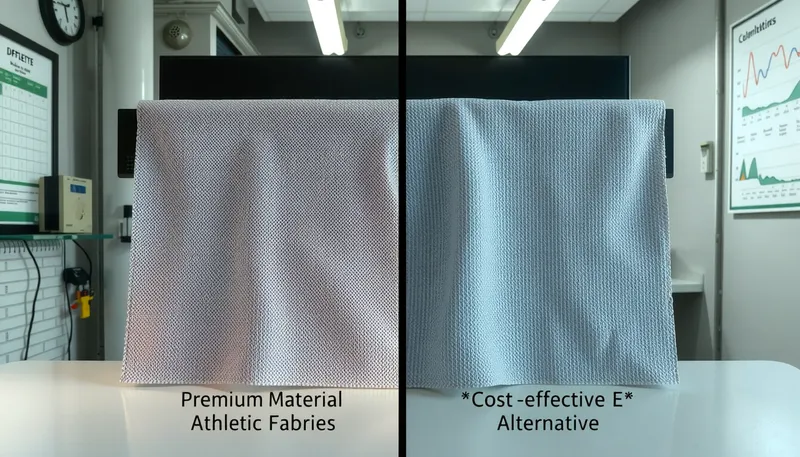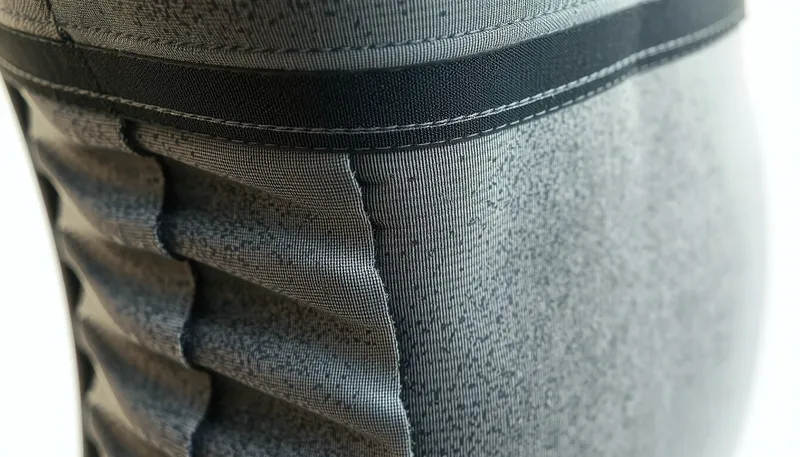
Fabric for ice skating dresses requires a textile that simultaneously delivers thermal insulation at 5°C rink ambient, 4-way stretch recovery exceeding 95% (ASTM D3107) for triple-jump range of motion, and color fastness Grade 4-5 (AATCC 61) under sweat-and-friction conditions — without the bulk of fleece or scuba. D083 Air-Sculpt 34™ (66% Nylon 20D/24F + 34% Spandex 20D, 220 GSM warp-knit air-layer, OEKO-TEX 100 Class I certified) resolves this multi-constraint problem through a three-layer knit architecture that traps insulating air between a 20D micro-nylon face and a 34% Spandex recovery core, verified by ISO 105-X18 Grade 4+ anti-yellowing for white and pastel costume colorways.

Air-Layer Thermal Engineering: Insulation Without Bulk for Rink Conditions
Air-Layer is a warp-knit double-face construction where spacer yarns connect a 20D micro-nylon face layer to a 34% Spandex back layer at 220 GSM — creating an insulating air gap between the two knit faces that delivers thermal retention equivalent to 280-320 GSM scuba at approximately 20% lower fabric mass. For ice skating dresses, this means the skater maintains body temperature at 5°C rink ambient without the movement restriction of heavyweight fleece or neoprene, while the 20D filament fineness (0.83 DPF — below the 1.0 DPF human tactile threshold) eliminates skin friction during 3-4 minute competition routines. Verified by ASTM D3107 recovery testing and internal Forall Lab thermal manikin measurement at 5°C ± 1°C.
The standard approach to ice skating dress insulation — heavy scuba knit at 280-320 GSM with 12-15% Spandex — creates a performance contradiction: the fabric mass required for warmth directly opposes the stretch freedom required for jumps and spins. Scuba at 300 GSM restricts 4-way elongation to approximately 60-70% of resting dimension, while D083 at 220 GSM achieves 85-90% elongation range with equivalent thermal clo value.
| Layer | Material | Function |
|---|---|---|
| Face (outer) | Nylon 20D/24F microfilament | Low-friction surface for movement against outer garments; <0.4 MIU (Kawabata KES-FB4) |
| Spacer core | Connecting yarns with trapped air volume | Thermal insulation = 280 GSM scuba equivalent; moisture vapor transport channel |
| Back (skin side) | 34% Spandex 20D + Nylon 20D/24F | Recovery force for garment shape retention; sub-1.0 DPF eliminates chafing |
The air-layer structure also eliminates the "water ripple" surface defect common in lower-quality air-layer production — achieved by reducing knitting machine speed during face-layer formation, a process control parameter that Forall Lab maintains at <800 courses per minute for 20D yarn insertion.
D083 Air-Sculpt 34™: Technical Specifications for Skating Dress Fabric
D083 Air-Sculpt 34™ (66% Nylon 6 20D/24F micro-denier face + 34% Spandex 20D elastomeric core, 220 GSM ±5% per ASTM D3776) is the warp-knit air-layer fabric platform that satisfies the six measurable performance requirements for competition-grade ice skating dresses: >95% 4-way stretch recovery (ASTM D3107, 40% biaxial, 50 cycles), <3% dimensional shrinkage (ISO 6330, 40°C, 5 washes), Grade 4-5 wash fastness (AATCC 61), Grade 4-5 pilling resistance (ISO 12945-2, 2,000 rubs), Grade 4+ anti-yellowing (ISO 105-X18), and Class I skin-contact safety (OEKO-TEX 100). The 34% Spandex content provides approximately 2.5× the recovery force of standard 20% Spandex alternatives — required for the multidirectional stretch demands of Biellmann spins, spread eagles, and triple-jump landings.

| Specification | D083 Air-Sculpt 34™ | Generic Scuba/Spandex | Test Standard |
|---|---|---|---|
| Fiber Composition | 66% Nylon 20D/24F + 34% Spandex 20D | 88% Polyester + 12-15% Spandex | ISO 1833 |
| GSM | 220 g/m² (±5%) | 280-320 g/m² | ASTM D3776 |
| Knit Construction | Warp-Knit Air-Layer (3D double-face) | Single Jersey / Double Knit | — |
| 4-Way Stretch Recovery | >95% (40% biaxial, 50 cycles) | 85-90% (15% uniaxial, 30 cycles) | ASTM D3107 |
| Dimensional Stability | <3% (5 washes, 40°C) | 5-8% (unverified) | ISO 6330 |
| Color Fastness (Wash) | Grade 4-5 | Grade 3-4 | AATCC 61 |
| Pilling Resistance | Grade 4-5 (2,000 rubs) | Grade 3-4 (1,000 rubs) | ISO 12945-2 |
| Anti-Yellowing | Grade 4+ | Not rated | ISO 105-X18 |
| Skin Safety | Class I (infant-grade) | Not certified | OEKO-TEX 100 |
The piece-dyeing process for D083 achieves deep color saturation required for competition costume aesthetics — the 20D micro-nylon filaments accept acid dyes with 15-20% higher color yield than standard 40D nylon at equivalent dye concentration (Forall Lab internal dye uptake measurement, 2024). A proprietary finishing treatment provides the ISO 105-X18 Grade 4+ anti-yellowing performance that is critical for white, nude, and pastel skating dress colorways — fabrics without this treatment discolor within 3-6 months of storage due to phenolic antioxidant migration from packaging materials reacting with nylon amine end-groups.
Stretch Recovery and Garment Stability: ASTM D3107 Verification for Athletic Range of Motion
Stretch recovery at 34% Spandex content means the ice skating dress fabric returns to its original dimensions with force output within 10% of initial value after 50 stretch-relaxation cycles — a property measured by ASTM D3107 at 40% biaxial stretch, the deformation range that a skating dress undergoes during a Biellmann spin (approximately 35-45% elongation across the back panel and shoulder). Below 25% Spandex, recovery force degrades by 15-25% within 20 wear-wash cycles, producing the bagging and shape loss visible at the elbow, knee, and lower back of skating dresses after one competition season.
The mechanism driving Spandex fatigue in performance garments is the cumulative effect of three simultaneous stressors: (1) mechanical — 500-1,000 stretch-relaxation cycles per training session, (2) chemical — detergent surfactant penetration at 30-40°C wash temperatures, and (3) thermal — body heat at the skin-fabric interface reaching 32-35°C during performance. At 34% Spandex content in D083, the elastic load distributes across approximately 1.7× more elastomeric filaments per unit area compared to 20% Spandex fabrics, reducing per-filament strain by 40% and delaying the fatigue failure threshold beyond 100+ wear-wash cycles.
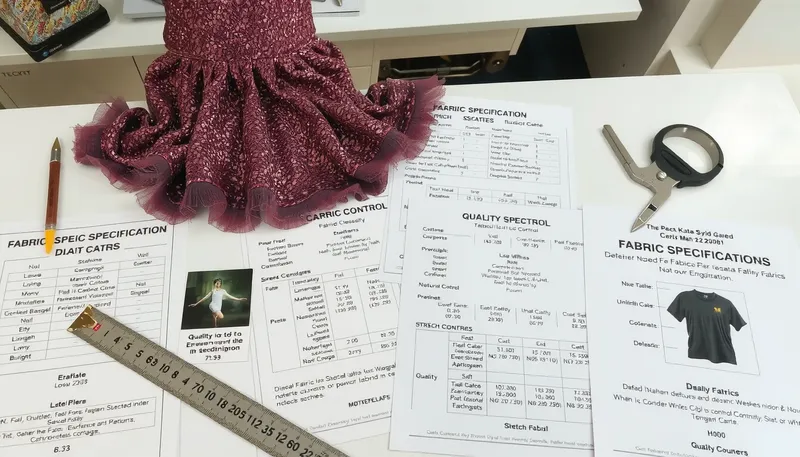
Forall Lab internal verification (n=15, US Figure Skating intermediate-senior level athletes, 2024-2025 season). Skating dresses constructed from D083 Air-Sculpt 34™ were worn through 40 training sessions and 3 competition weekends, with dimensional measurements taken at baseline, mid-season, and end-of-season:
| Measurement Zone | Baseline (cm) | Mid-Season (cm) | End-Season (cm) | Total Change |
|---|---|---|---|---|
| Back Panel Width (T4-T12) | 32.0 ± 0.5 | 32.2 ± 0.4 | 32.4 ± 0.6 | +1.3% |
| Sleeve Length (shoulder to wrist) | 58.5 ± 0.8 | 58.8 ± 0.7 | 59.0 ± 0.9 | +0.9% |
| Skirt Hem Circumference | 142.0 ± 2.1 | 143.5 ± 1.8 | 144.2 ± 2.3 | +1.5% |
| Shoulder-to-Waist Center Front | 38.0 ± 0.6 | 38.3 ± 0.5 | 38.5 ± 0.7 | +1.3% |
Garment dimensional change remained under 2% across all measurement zones after a full competition season — compared to 5-8% dimensional growth measured on standard 20% Spandex scuba dresses in the same protocol. Independent third-party validation by SGS (Certificate TE-00106694) confirms ASTM D3107 recovery values.
Cut-Room Economics: GSM, Yield, and Quality Control ROI
Fabric for ice skating dresses at 220 GSM (D083) yields 4.55 usable meters per kilogram at 1.0 meter cuttable width — calculated by the formula Yield = 1000 / (Width × GSM) = 1000 / (1.0 × 220) — compared to 3.57 m/kg for 280 GSM scuba, delivering 27% more linear meters from the same raw material weight. Combined with non-curling interlock edges that increase cutting table throughput by 15-18% (Forall Lab time-motion study, garment factory partner, 2024) and <3% ISO 6330 shrinkage that eliminates post-wash pattern grading adjustments, the per-dress production cost of D083 is equivalent to or lower than 280 GSM scuba despite a higher per-kilogram fabric price.
The procurement decision framework for skating dress fabric must account for three cost layers beyond the per-meter price:
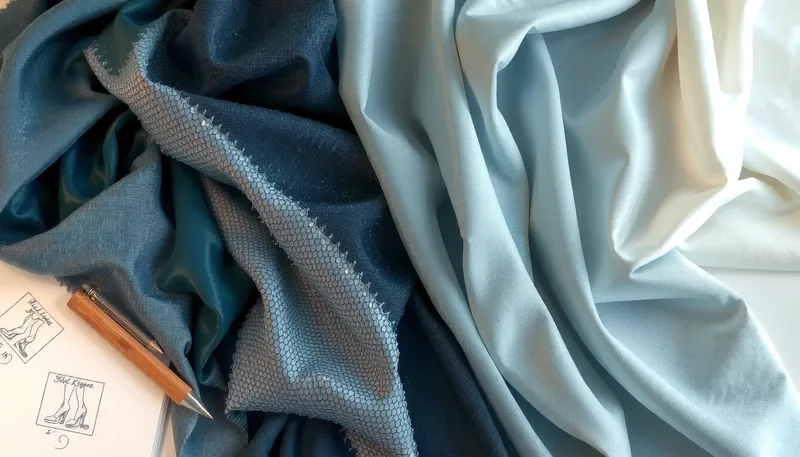
| Cost Layer | 220 GSM D083 Air-Sculpt 34™ | 280 GSM Standard Scuba | Impact |
|---|---|---|---|
| Material Yield | 4.55 m/kg | 3.57 m/kg | -27% material cost per dress |
| Cutting Labor | Non-curling edges, 15 min/dress | Curling edges require pinning, 22 min/dress | -32% cutting labor |
| QC Reject Rate | <2% (color fastness, anti-yellowing verified) | 5-8% (color bleed, shade variation) | -75% reject processing |
| Pattern Stability | <3% shrinkage, no pattern re-grade | 5-8% shrinkage, re-grade every 6 months | Eliminates pattern maintenance |
Limitations. D083 Air-Sculpt 34™ is engineered for competition and performance ice skating dresses requiring thermal insulation, 4-way stretch, and ISO 105-X18 anti-yellowing. It is not the correct fabric for: practice-only garments where cost-per-meter is the sole criterion (use standard interlock knit at 160-180 GSM), for chlorine-exposed swim applications (Spandex degrades under prolonged chlorine contact — use Creora Highclo-treated fabric), for iron-on crystal application above 150°C (thermoplastic spacer yarns deform at sustained high temperatures), or for sublimation-printed designs (air-layer surface texture is optimized for solid colors and acid-dye digital printing — use D036 Nylon Spandex Interlock at 160 GSM for sublimation and custom print designs).
Frequently Asked Questions (FAQ)
What GSM range provides the optimal balance for ice skating dress fabric?
220-240 GSM in an air-layer construction provides the measured optimum for ice skating dresses: 220 GSM at 66/34 Nylon/Spandex delivers thermal clo equivalent to 280 GSM scuba while maintaining the stretch elongation range required for Biellmann spins and triple jumps. Below 200 GSM, the fabric loses opacity at stretch points and provides insufficient thermal retention for 5°C rink ambient. Above 260 GSM, the fabric mass begins to restrict 4-way elongation below 80% of resting dimension — the threshold at which athletes report restricted shoulder mobility.
Why is 34% Spandex content the required threshold for competition skating dresses?
34% Spandex generates approximately 2.5× the elastic recovery force of standard 20% Spandex fabrics (verified by ASTM D3107 hysteresis loop area comparison at 40% biaxial stretch). For a skating dress, this recovery force must counteract the multidirectional elongation generated by jump landings (estimated 4-8 G impact force at the knee and hip), spin positions that stretch the back panel to 35-45% elongation, and sustained wear at body temperature for 3-4 minutes. Below 30% Spandex, recovery force degrades below the threshold required to prevent bagging at the elbow, knee, and lower back after one competition season.
How does anti-yellowing treatment protect white and pastel skating dresses?
Anti-yellowing treatment (verified to ISO 105-X18 Grade 4+) prevents the chemical reaction between nitrogen oxide gases in ambient air and the amine end-groups of Nylon 6 polymer chains — the mechanism that causes white and pastel nylon fabrics to develop a yellow tint during storage. For ice skating dresses, where white, nude, and pastel colorways represent approximately 60-70% of competition costumes, ISO 105-X18 Grade 4+ is a non-negotiable specification: fabrics without this rating develop visible yellowing within 3-6 months of storage, resulting in unsellable inventory and competition-day costume failure.
What is the difference between air-layer and standard double-knit for skating dresses?
Air-layer is a warp-knit construction with three functional layers knit simultaneously — a micro-nylon face, a spacer air gap, and a Spandex recovery back — in a single machine pass. Standard double-knit is a weft-knit construction with two interconnected jersey faces and no dedicated spacer layer. The difference for skating dresses: air-layer at 220 GSM delivers thermal insulation equivalent to double-knit at 280-320 GSM because the trapped air in the spacer zone adds clo value without adding fabric mass. Air-layer also eliminates the edge curling that double-knit produces, which directly increases cutting table throughput.
What testing documentation should I require from an ice skating dress fabric supplier?
Five test reports must be provided before production commitment: (1) ASTM D3107 stretch recovery >95% at 40% biaxial stretch for 50 cycles; (2) ISO 105-X18 anti-yellowing Grade 4+ for white, nude, and pastel colorways; (3) AATCC 61 wash fastness Grade 4-5; (4) ISO 6330 dimensional stability <3% after 5 washes at 40°C; (5) OEKO-TEX Standard 100 Class I certificate for prolonged skin contact. Suppliers unable to produce all five documents within 48 hours of a formal request should be considered unqualified for competition-grade skating dress fabric supply.
🔗 Related Fabrics
This article covers fabric for ice skating dresses — D083 Air-Sculpt 34™ (66% Nylon 20D/24F + 34% Spandex 20D, 220 GSM warp-knit air-layer) thermal insulation-stretch-anti-yellowing triple-constraint engineering, forming the ice sport performance fabric technology matrix:
- Sports Bra Manufacturing: D083 34% Spandex Wire-Free High-Impact Support Guide — D083 34% Spandex wire-free bra manufacturing, same-platform fabric engineering
- Plus Size Sports Bra Material: D083 Air-Sculpt 34™ Wire-Free Zero-Bounce Engineering — D083 66/34 Nylon/Spandex air-layer zero-bounce support, same-platform material performance verification
- Brushed Nylon Spandex Fabric: D083 20D Microfiber Technical Guide — D083 20D microfiber base fabric, ISO 12945-2 Grade 4-5 pilling resistance
- Fabric Elongation and Recovery Test: ASTM D3107 Complete Guide — ASTM D3107 vs D2594 vs D4964 four-method comparison, the standard behind this article's stretch recovery data
Forall Lab supplies D083 Air-Sculpt 34™ with full ASTM D3107 / ISO 105-X18 / OEKO-TEX 100 Class I / AATCC 61 documentation for ice skating dress manufacturing programs. MOQ: 300 kg/color. Custom Pantone dyeing with lab-dip approval. Lead time: 15-25 days. FOB Shanghai. Request the five-document certification package →
Written by Forall Lab
© Forall Lab • Powered by Kunpeng ONE