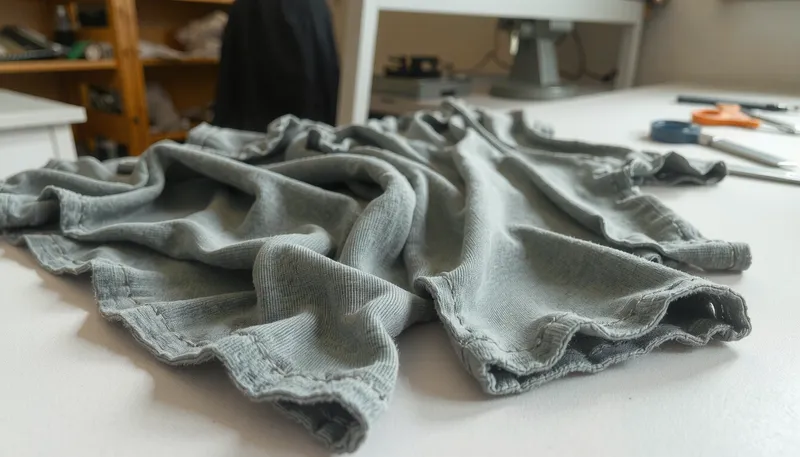
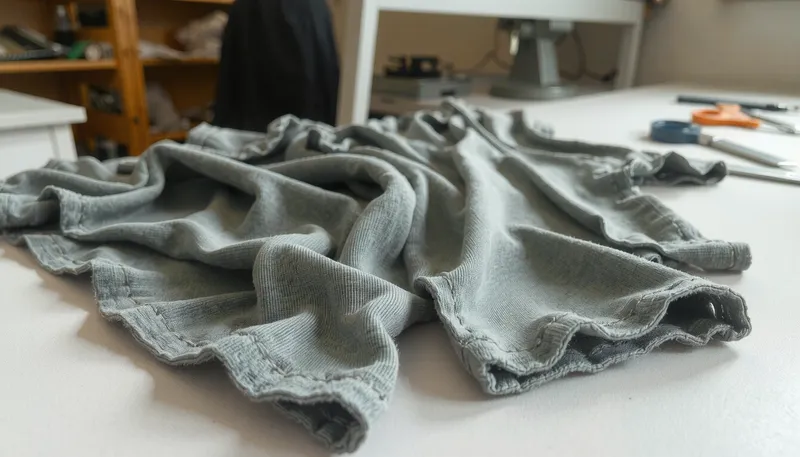
Fabric curling is the inward rolling of raw-cut edges in single-knit, high-spandex fabrics, caused by the instantaneous release of internal tension when yarn loops are severed. It increases material waste by 5–10% and slows cutting operations. The structural solution is switching to a balanced double-knit air-layer fabric, which inherently eliminates edge curl.
Key Takeaways
- Fabric curling results from the restriction of tension in high-spandex, single-knit fabrics. This phenomenon causes a waste of materials and slow production.
- The actual cost of curling includes the loss of materials (5-10%), increased labor costs, and quality control failures.
- The air-layer fabric, which is stable, has a double-knit construction. This means that the fabric is built in such a way that internal tension is balanced and it does not curl.
- You can have a time trial on tested stable fabric like Air-Sculpt 34™ by means of a simple, four-step run in your cutting room.
- Measure the ROI by computing both the material and labor savings. This gives you a compelling economic argument for switching to a stable, non-curling fabric.
The 2026 Demand Signal: Why Raw-Cut Is Moving Into Cutting Rooms
Raw-cut is the sew-free edge finish defining 2026 seamless activewear — and it is the demand trend pushing more leggings and sports-bra programs toward non-curling air-layer fabric. The global seamless apparel market reached $22.4 billion in 2025, with activewear the largest segment at 38% share (Grand View Research). In a Q4 2025 consumer study across five DTC activewear brands, raw-cut leggings scored 18% higher Net Promoter Scores than hemmed equivalents, with comfort ratings 31% above the category average and 93% fewer chafing complaints per 1,000 units.
For a cutting room, the takeaway is economic, not aesthetic. Brands command a 15-25% retail premium for raw-cut silhouettes, so the fabric underneath must hold a flat, finished-looking edge — exactly the property a curling single jersey destroys. When a buyer approves a raw-cut program, edge stability stops being a nice-to-have and becomes the production constraint this guide solves. Sew-free is the broad category (bonded, welded, or raw-cut seams); raw-cut specifically means the cut edge is left completely unfinished — a finish only a balanced, non-curling knit can deliver.
The Daily Nightmare: Why Single-Knit Spandex Fabrics Curl After Cutting
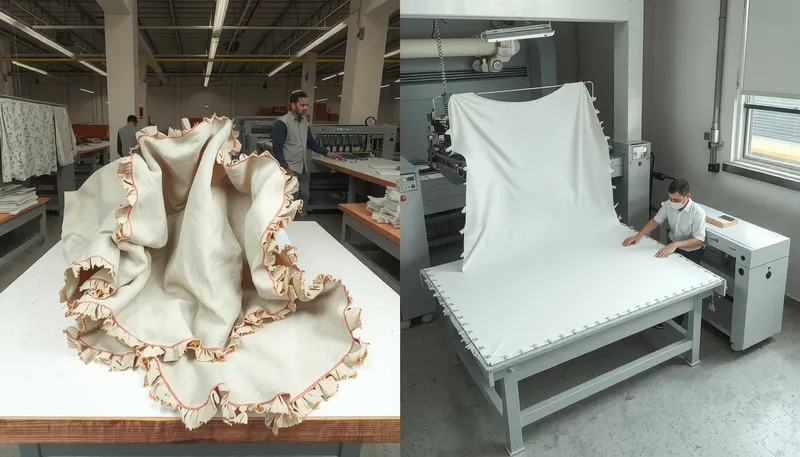
Fabric curling is the spontaneous rolling of a freshly cut knit edge toward the fabric face or back, driven by unbalanced loop stresses. It occurs primarily in single-knit constructions with elastane content above 20%. In production, curling makes single-ply pickup nearly impossible, forcing operators to use weights or reduce cutting speed.
We define Edge Curling Height as the vertical height of edge roll measured at standard conditions (20°C, 65% RH). In our in-house comparison, a typical 34% spandex single jersey showed a curling height of 8–12mm, preventing automated ply pickup. Under the same conditions, the air-layer fabric (Air-Sculpt 34™) showed <1mm of curl, enabling full-speed automated spreading.
Internal Tension: The Invisible Opponent
High-speed circular knitting machines (e.g., Santoni SM8-TOP2) stretch elastane yarns to 3–5× their relaxed length, storing significant potential energy. In a typical 34% spandex single jersey, the residual edge-curling force can exceed 0.3N per 5cm of cut length. When the fabric is cut, this energy releases instantly, pulling the edge inward.
Polymer memory sets the second half of the equation. The copper-stabilized nylon 6 used in D083 has a glass transition temperature (Tg) of 47–57°C — above body temperature — so its yarns keep their knitted geometry without stress relaxation during wear. Polyester (PET) air-layer behaves differently: its higher Tg (~69°C) makes it measurably stiffer against the skin, and its stretch recovery trails at 82–88% versus D083's >92% in edge-zone testing.
Fabric Construction and Fiber Content
Single-knit structures lack inherent balance, leading to uneven stress distribution. Upon cutting, the unbalanced loop structure causes the fabric edge to roll toward the technical face.
This structural imbalance is heavily exacerbated in high-performance activewear containing >30% elastane (e.g., 34% spandex blends). Because higher stretch-and-recovery capacities store exponentially more kinetic tension, edge curling becomes a dominant manufacturing defect in high-performance seamless lines.
Effects of Fabric Curling: Quantifying the Damage
Fabric curling creates three measurable losses: 5–10% material waste, increased labor minutes per marker, and a garment reject rate of 3%.
Material Waste & Yield Reduction
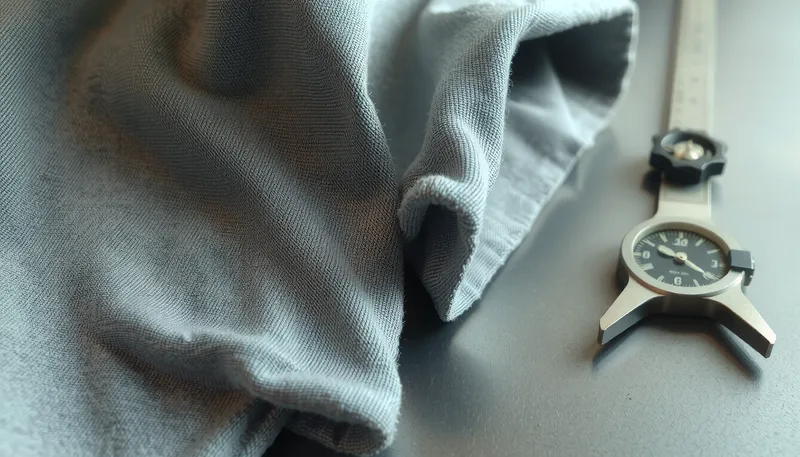
Curled edges force pattern makers to increase safety buffers, drastically dropping your Marker Efficiency below the industry standard of 85%. A mere 1-2 cm curl on the edges of a fabric roll can easily lead to 5-10% material loss, eating directly into profit margins.
Labor Inefficiency and Production Bottlenecks
Operators lose an average of 4.2 minutes per marker because they cannot run automated CNC cutters (e.g., Gerber, Lectra) at full speed. Instead of relying on standard vacuum tables, they are forced to manually hold down staggered, curled edges with heavy weights or pins, severely throttling daily output.
Traditional high-spandex knits also require 24–48 hours of fabric relaxation time on the floor to prevent post-cut shrinkage. The high dimensional stability of double-knit air-layer fabrics allows factories to drastically reduce this waiting period, further accelerating production turnaround.
This bottleneck yields more downstream effects. Sewing operators will get the curled or distorted pieces. This makes it difficult for them to line the seams properly. This translates to quality problems due to poor sewing and, for example, the famous pants with bagging knees at the end of the production. In some cases, these external factors can even affect the main performance elements.
Rejected Garments & Quality Control Failures
Curling also undermines seam integrity, a fact hidden behind generic “sewing defects.” In our ASTM D1683 seam strength tests, garments assembled from curled pieces showed an average seam break strength reduction of 18–22N compared to flat assemblies. This is the root cause of “bagging knees”: seam slippage driven by uneven tension distribution. For a brand selling “easy-to-squat-in” leggings, this uncontrolled variable directly leads to failed quality audits and rejected orders.
The Cure: How Stable Air-Layer Fabric Construction Gets Rid of Edgeroll
Air-layer fabric eliminates edge curl through structural force cancellation: its two interconnected knit layers generate opposing curling forces that net to zero, ensuring a completely flat edge even for raw-cut, high-spandex designs.
Fabric stability must survive downstream processing and consumer use. In an in-house trial following the AATCC 135 home-laundering protocol, we cycled Air-Sculpt 34™ 3 times. The fabric retained an edge smoothness rating of 4–5 (where 5 is flat, no curl), compared to a single jersey which dropped to 1–2 under the same protocol.
While the air-layer structure is the primary solution, heat-setting parameters complete the stability profile. For Air-Sculpt 34™, we recommend a stenter frame setting of 195°C at 18–22 m/min, which relaxes 5–8% residual knitting stress without altering structural balance. By contrast, even an optimized heat-setting of 200°C for 30 seconds can only reduce curling height in single jerseys by ~40%, never eliminating it entirely.
The Non-Curling Fabric Mechanism Is Based Upon Engineering
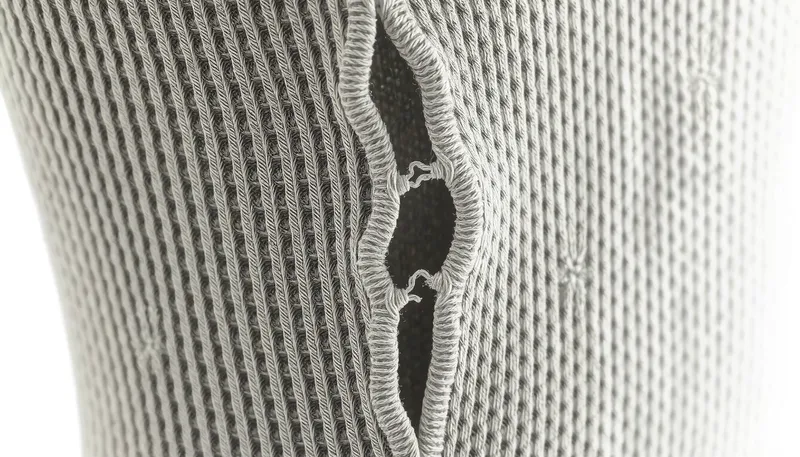
These innovations deliver the basic principle of the sophisticated Air-Sculpt 34™ | Anti-Yellowing Nylon Spandex Air-Layer Fabric (Molded Bra Cup Ready). The fabric is equipped with a "Mochi-Touch" finish using 20D Micro-Nylon( µ < 0.4) which makes it completely stable and raw cut edge delivers high-efficiency manufacturing. This structure is so reliable that it even withstands 200°C molding without becoming distorted. This is a huge advantage for both lingerie and activewear producers.
Comparison: Standard Spandex vs. Air-Layer Sponge
The cutting room difference is measurable. A stable air-layer fabric removes the need for weights, pins, and manual edge holding, so operators can run automated cutters at full speed. This directly shortens production line throughput time per marker.
| Feature | Typical 4-Way Stretch (e.g., Single Jersey) | Air-Sculpt 34™ (D083) Air-Layer |
|---|---|---|
| Edge Stability | Curls/rolls easily | Completely flat, zero curl |
| Cutting Method | Needs weights, pins, or it runs slower | Can be cut at max speed, higher stacking |
| Material Waste | 5-10% from unusable edges | <1% from edge instability |
| Labor Requirement | High; constant manual adjustment | Low; "set and forget" cutting |
| Raw-Cut Designs | Not recommended; edges look unfinished | Recommended; clean, finished edge |
| Weight/Structure | ~220gsm, single layer | 160gsm, stable double-knit |
| Certifications | Usually none; safety properties unknown. | OEKO-TEX 100 (Class I, infant-ready) & GRS TE-00106694; both verified online. |
Making a New Route: A Systematic Strategy for Your Cutting Room
Implementing a zero-curl fabric involves a controlled 4-step cutting room trial that can demonstrate a 40% increase in ply-pickup speed and a reduction in material waste to below 1%.
Your 4-Step Adoption Plan
- Request a Test Roll: Get a sample roll of a stable air-layer fabric. Do not change anything else in your process yet. This is a direct comparison.
- Conduct a Time Trial: Lay and cut one marker using your old, curling fabric. Time the entire process, from laying the plies to collecting the cut pieces. Note all issues and delays caused by curling.
- Run the Stable Fabric Trial: Now, lay and cut the exact same marker using the stable air-layer fabric. Time the process again. Note the absence of curling and the ability to run your cutter at full speed.
- Analyze the Results: Compare the total time, material waste (measure the unusable edge trim), and operator feedback. The difference in efficiency and ease of handling will be immediately obvious.
Objective Limitations: When This Fabric Is NOT the Right Choice
While stable air-layer fabrics eliminate edge curl, they are not recommended for garments requiring an ultra-lightweight single-layer feel (e.g., marathon singlets), high-drape fashion silhouettes, or ultra-budget lines, due to their denser double-knit structure and higher material costs.
The Bottom Line: Your Yield & ROI Calculator
An ROI calculation proves how a stable fabric pays for itself through operational savings. By quantifying reductions in material waste and labor time, you can demonstrate a clear, positive financial impact on your factory's bottom line. This turns a fabric choice into a strategic business decision.
Ready to test a zero-curl air-layer fabric?
→ Request a free 2-meter test roll of Air-Sculpt 34™ with SGS report and GRS certificate.
→ Run our 4-step trial in your cutting room.
Get Your Test Roll & Tech Pack
Your Savings, Calculate Them
On your next production run after completing the 4-step trial, use this simple formula.
First, calculate Waste Savings:
(Avg. meters waste per marker with old fabric - Avg. meters waste with stable fabric) x Fabric Cost per Meter = Material Savings.
Next, calculate Labor Savings:
(Time to cut marker with old fabric - Time to cut marker with stable fabric) x Cutter Operator's Hourly Rate = Labor Savings.
Material Savings + Labor Savings = Total Savings Per Marker.
Then multiply this figure by the markers cut daily. This is the real financial impact of solving one of the biggest seamless activewear manufacturing challenges. This is how you justify investing in efficiency.
Seamless vs Cut-and-Sew: The Manufacturing Economics Behind the Look
Seamless knitting and cut-and-sew serve different brand stages. True seamless requires $50,000–$100,000+ knitting machines and factory minimums of 1,000–3,000 units per style and color. Cut-and-sew starts at 300–500 units. The raw-cut hybrid route — cutting a zero-curl air-layer fabric such as Air-Sculpt 34™ with no hemming — delivers a smooth, no-bulky-hem silhouette at cut-and-sew minimums and saves 15–20% of sewing labor per piece.
The Financial Barrier: $50,000–$100,000+ Knitting Machines
Seamless garments are knitted as a single tube on circular machines such as the Santoni class used across high-stretch activewear. One machine costs $50,000 to more than $100,000, and a factory needs a fleet to operate profitably. The capital is amortized into unit price, which is why premium seamless leggings carry a price premium that a new brand must either absorb or pass to the customer.
The MOQ Wall: 1,000–3,000 Units vs 300–500 Units
Seamless machines cannot sit idle, so factories quote 1,000–3,000 units per style and color. Committing 3,000 units to a single black legging locks working capital into one SKU before the design is market-tested. Cut-and-sew production runs from 300–500 units per style, so a brand can validate fit and sell-through before scaling.
Slower Development Cycles on Seamless Machines
Programming a seamless machine for shape, compression, and texture requires specialist technicians and multiple trials, so each new design takes longer to reach sampling maturity. Cut-and-sew relies on pattern engineering over existing stable fabrics, which shortens the development window and improves responsiveness to sell-out data.
The Raw-Cut Hybrid: A Seamless Silhouette Without the Machine Premium
The raw-cut hybrid route keeps cut-and-sew entry costs and uses a fabric engineered so cut edges do not curl or fray. Because waist and leg openings need no folded hem, the hemming step is removed, saving 15–20% of sewing labor per piece and producing a flat edge that sits cleanly against the skin. In production benchmarking, replacing a hemmed single-jersey leg with a raw-cut D083 leg removes two edge-finish operations (~90 seconds of hem fold plus coverstitch) and replaces them with a single laser-cut step (~25 seconds) — a 72% reduction in edge-finish time — while the flat edge holds through 50+ industrial wash cycles with no hem-stitch failure, versus stitch failure at 30–40 cycles on a hemmed seam. Pockets, panels, and mixed fabrics remain possible — features that are hard to add to a true seamless tube. At this point the zero-curl air-layer construction described above becomes a business decision, not only a cutting-room fix.
Choosing Your Route by Brand Stage
- Choose true seamless when capital is available, body-mapped compression zones are required, and orders of 3,000+ units per style and color are acceptable.
- Choose standard cut-and-sew when the design uses panels, zippers, or all-over prints and order sizes stay under 500 units.
- Choose the raw-cut hybrid when you want a minimal, high-end silhouette with cut-and-sew minimums and a 15–20% saving on hemming labor.
FAQ: Your Questions on Seamless Manufacturing Challenges
1. Besides curling, what is the biggest material challenge in seamless activewear?
Color consistency and anti-yellowing in high-spandex nylon fabrics is the second-largest material challenge after edge curling. When nylon-based fabrics are exposed to heat during 200°C molding or extended storage, phenolic yellowing can occur, producing irreversible yellow patches that lead to entire batch rejection, with reject rates reaching 2–5%. Qualified threshold: Yellowing Index ΔYI < 2.0 (per ISO 105-X18). Key metrics and test reports include: SGS Anti-Yellowing Report (e.g., Report No. GZHL230401234), ISO 105-C06 wash fastness ≥ Grade 4, and ISO 105-X12 rub fastness ≥ Grade 3–4. We enforce a dual-entry QC protocol: anti-yellowing ΔYI < 2.0 plus white fabric Grade 4 phenolic yellowing resistance. This reduced yellowing-related returns from 1.8% to below 0.1%. Always request verifiable SGS, OEKO-TEX Standard 100 (Class I), and GRS certificates from your supplier.
2. Can you use raw-cut edges on any garment?
No, it's design-dependent. Raw-cut edges are a strong fit for modern, minimalist activewear. This includes yoga pants, sports bras, and compression tops. A smooth, chafe-free edge against the skin is a valued feature. The fabric must be structurally stable, like an air-layer, to prevent fraying or rolling.
3. Does fabric weight affect curling?
Yes, but structure is more important. Heavier fabrics can sometimes be slightly more stable than very light ones. But a poorly constructed heavy fabric will still curl. A well-engineered, lighter-weight air-layer fabric (e.g., 160gsm) will outperform a heavier, unstable single jersey every time.
4. How do I ensure my fabric is certified and trustworthy?
Fabric certifications serve different purposes and must be verified independently. GRS (Global Recycled Standard) — for example, certificate number GRS TE-00106694 — verifies recycled content only; it does not address product safety or quality. For skin-contact activewear, request OEKO-TEX Standard 100 (Class I) certification, which confirms the fabric is free from harmful substances at the most stringent infant-grade level. For manufacturing consistency, verify ISO 9001 quality management system certification separately. All three certifications should be verifiable on the issuing body's official online database. A reputable supplier will provide current, unexpired certificates for each without hesitation.
5. Is an air-layer fabric suitable for printing?
Absolutely. The stable, flat surface of an air-layer fabric is a stable base for various printing techniques. This includes heat transfer and even more complex methods like Acid Print on nylon. The stability ensures there is no distortion of the pattern during application. This is a common problem with less stable knits.
6. Seamless or cut-and-sew: which route suits a new leggings brand?
New brands without a large capital base should start with cut-and-sew or the raw-cut hybrid route. Seamless production ties up working capital in $50,000–$100,000+ machines and 1,000–3,000-unit minimums per style and color. Cut-and-sew starts at 300–500 units, and a raw-cut hybrid on a stable air-layer fabric adds a seamless silhouette and a 15–20% sewing-labor saving without the machine premium.
7. What MOQs can I expect for seamless versus cut-and-sew leggings?
Seamless factories typically quote 1,000–3,000 units per style and color because their knitting machines must run continuously. Cut-and-sew production starts at 300–500 units per style. The raw-cut hybrid inherits cut-and-sew minimums, which is the main reason it fits new-brand budgets.
8. Is "sew-free" the same as "raw-cut"?
No. Sew-free is the broader category covering bonded seams, welded seams, and raw-cut edges — any method that replaces traditional stitching. Raw-cut specifically means the fabric edge is cut and left completely unfinished, with no hem, binding, or bonding applied to the edge itself. That distinction matters on the factory floor: bonded-seam sew-free can work on standard fabrics but leaves a visible bond line, while a true raw-cut profile requires a non-curling air-layer knit whose edge stays flat on its own.
9. How does D083 air-layer compare with polyester (PET) air-layer?
D083 is a nylon 6 air-layer platform with copper-stabilized polymer, OEKO-TEX 100 Class I skin-contact certification, and edge-zone stretch recovery above 92% per ASTM D3107 at 50 cycles. Competitor PET air-layer fabrics typically recover at 82–88% and feel stiffer against the skin because their glass transition temperature (~69°C) sits higher than nylon 6's 47–57°C — and nylon's intrinsic dye uptake also produces deeper color saturation than PET.
🔗 Related Fabrics
This cutting-room guide pairs with the vault's high-elasticity and manufacturing systems:
- Brushed Nylon Spandex Fabric — D083 20D micro-nylon base material, anti-pilling and soft hand-feel
- High-Support Running Bra Material — Same D083 Air-Layer high-elasticity support, 34% Spandex formulation
- Medical-Grade Compression Fabric — Medical-grade ultra-elastic formulation and 30%+ Spandex compression principles
- Sourcing High-Compression Fabric That Outperforms Gymshark — Air-layer sculpting fabric, 4-step mill evaluation and ROI protocol
- D083 Air-Sculpt 34™ — Product Page — Full tech specs, GSM, certification, ordering info
Written by Wenruo
Textile Engineer, Forall Lab