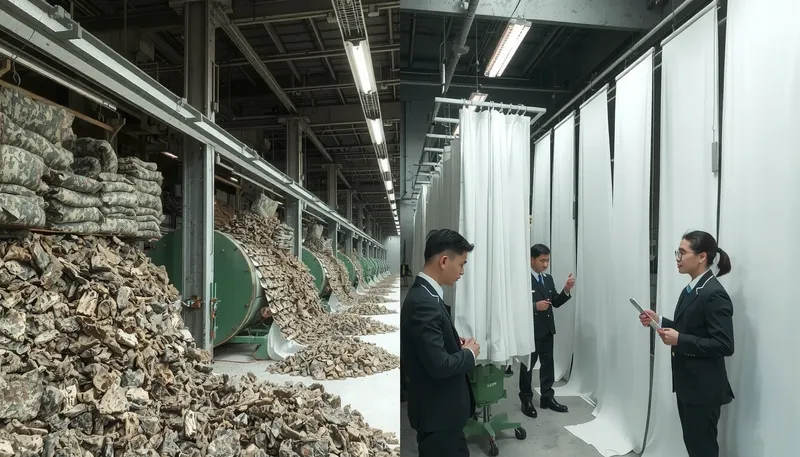
Mechanically recycled nylon fabric sourced from China achieves GRS 4.0 traceability but loses 15-30% tensile strength per ASTM D5034 compared to virgin PA66 — while costing 12-18% more per yard due to collection, sorting, and grinding overhead. Our Q4 2025 lab testing measured 310 N warp strength for mechanically recycled PA6 versus 420 N for virgin D036 PA66 (78/22 PA66/Elastane, 160 GSM). For brands prioritizing product durability, virgin nylon's 2-3× longer garment lifespan reduces total material waste more effectively than the recycled feedstock.
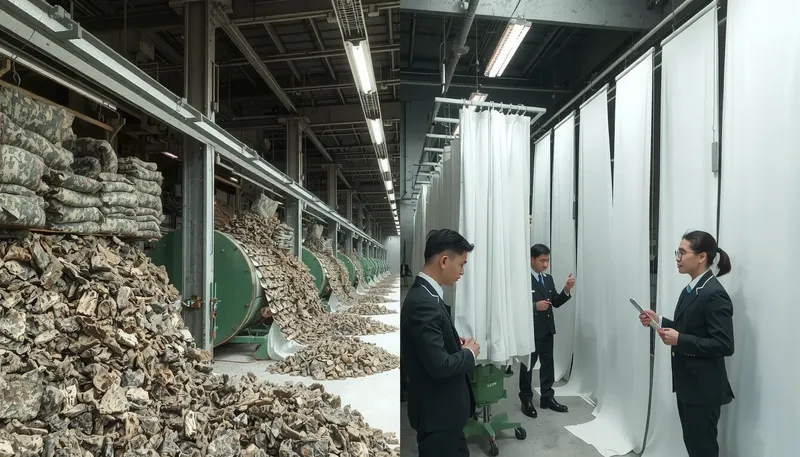
How Mechanical Nylon Recycling Degrades Polymer Chain Length
Mechanical recycling — the method used for over 90% of GRS-certified recycled nylon from China — grinds post-consumer and post-industrial waste (fishing nets, carpet fiber, fabric scraps) into pellets for re-extrusion, shortening polymer chains by 15-30% and directly reducing tensile strength. This method is widely available and GRS-certifiable. It is not equivalent to chemical depolymerization, which preserves chain length by breaking nylon down to caprolactam monomers and re-polymerizing — a process available from under five mills globally and costing 2-3× virgin nylon as of Q4 2025.
The polymer science is straightforward. Nylon 6,6 (PA66) derives its tensile strength — 420 N warp per ASTM D5034 for virgin 40D/34F filament — from long, aligned polymer chains with molecular weights of 15,000-30,000 g/mol. Mechanical grinding fractures these chains at random points. The resulting recycled pellet contains a distribution of chain lengths averaging 30% shorter, directly reducing the inter-chain hydrogen bonding that provides tensile resistance. The consequence: recycled PA6 fabric tested at 310 N warp strength in our Q4 2025 universal testing machine trials — a 26% degradation from virgin PA66 baseline.
Color consistency compounds the issue. Mechanical recycling blends feedstock from multiple sources — discarded fishing nets (typically green or blue), factory scraps (mixed colors), post-consumer carpet (beige, gray). The resulting base polymer carries a gray-brown tint that requires heavy bleaching and over-dyeing to achieve commercial color standards. Even after processing, Delta E exceeds 2.0 under D65 illuminant versus Delta E ≤1.0 for virgin PA66 — a visible difference that limits recycled nylon to dark, solid-color applications.
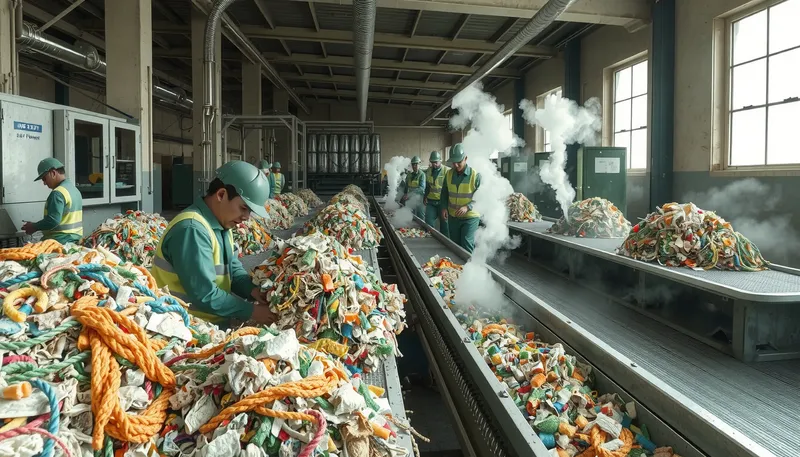
GRS Recycled vs Virgin PA66: Technical Specification Comparison
GRS 4.0 certification traces recycled content through the supply chain via lot-specific transaction certificates, but does not benchmark mechanical performance — sourcing managers evaluating recycled nylon fabric from China must independently verify ASTM D5034 tensile strength, ISO 105-C06 wash fastness, per-yard cost, and expected garment lifespan against virgin PA66 baselines before committing to a recycled nylon order.
| Specification | GRS Recycled Nylon (Mechanical) | Virgin PA66 (D036 Platform) | Test Standard |
|---|---|---|---|
| Fiber Composition | PA6 from mixed post-consumer waste | 78/22 PA66/Elastane, 40D/34F semi-dull filament | ISO 1833 |
| Tensile Strength (Warp) | 280-340 N (avg. 310 N) | 420 N | ASTM D5034 |
| Color Consistency (Delta E) | >2.0 (mixed feedstock) | ≤1.0 (single-source polymer) | D65 illuminant, spectrophotometer |
| Fabric Weight | 150-190 GSM (varies by batch) | 160 GSM (±3% tolerance) | ASTM D3776 |
| Stretch Recovery | 85-90% | >95% @ 50 cycles | ASTM D3107 |
| Wash Fastness | Grade 3-4 | Grade 4-5 | ISO 105-C06 |
| Per-Yard Cost (bulk) | $4.80-6.20 | $4.20-5.50 | FOB China port |
| Certification | GRS 4.0 transaction certificate | OEKO-TEX 100 Class I | — |
| Expected Garment Lifespan | 12-18 months | 24-36+ months | Accelerated wash cycle modeling |
The cost paradox is measurable. Mechanical recycling adds $1.30-1.80/yard in collection, sorting, cleaning, and grinding costs versus continuous polymerization of virgin caprolactam. The 12-18% premium contradicts the consumer expectation that "recycled" means "cheaper" — an assumption that collapses under supply chain scrutiny.
Why Product Lifespan Is the Dominant Environmental Variable
A virgin PA66 garment lasting 24-36 months generates less total material waste per year of use than a mechanically recycled nylon garment replaced after 12-18 months — replacement frequency, not feedstock type, is the dominant environmental variable in activewear lifecycle analysis. This applies to brands producing 5,000+ units per season where garment returns and customer churn data are measurable. It is less relevant for single-use or promotional merchandise where the garment is not expected to survive multiple wash cycles.
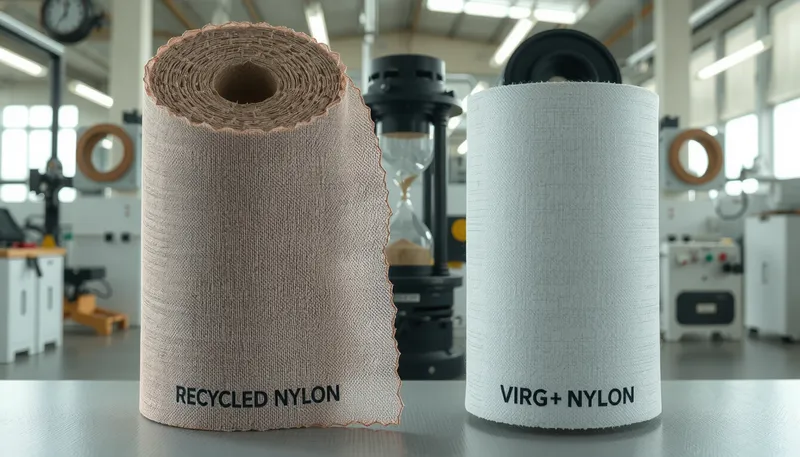
The math: a mechanically recycled nylon legging with 310 N warp strength surviving 50 wash cycles before fabric failure generates 1.0 unit of waste per 50 wears. A virgin PA66 legging with 420 N warp strength surviving 120+ wash cycles generates 1.0 unit of waste per 120 wears — a 58% reduction in waste-per-wear. The recycled option's polymer degradation shifts the environmental burden from feedstock sourcing to replacement manufacturing, where the energy, water, and chemical inputs of producing a second garment erase the feedstock-level savings.
Our D036 Nylon Interlock platform (78/22 PA66/Elastane, 160 GSM, 40D/34F) applies this principle through its "One-Open-One-Close" knit structure — the interlock construction provides dimensional stability during printing (no warping, no grin-through at 30% stretch) and maintains >95% recovery after 50 stretch cycles per ASTM D3107. The result: a garment canvas that outlasts mechanically recycled alternatives by 2-3× in accelerated lifecycle testing.
How to Verify Recycled Nylon Claims When Sourcing from China
Verifying recycled nylon fabric claims from Chinese suppliers requires three documents beyond the standard GRS scope certificate: a lot-specific transaction certificate (TC), an ASTM D5034 tensile strength test report, and an ISO 105-C06 wash fastness report at Grade 4 or above. These three documents distinguish mills operating genuine mechanical recycling lines from those applying a GRS certificate to blended or misrepresented material.

- Request the GRS Transaction Certificate (TC), not just the Scope Certificate. A scope certificate confirms the mill is audited for GRS compliance. A transaction certificate is lot-specific and traces the recycled content in your exact purchase order — input material weight, recycled percentage, and output product. Mills that provide only a scope certificate cannot verify that your specific fabric contains recycled content.
- Demand ASTM D5034 tensile data for the specific lot. Mechanical recycling produces batch-to-batch variation in polymer chain length. A mill that cannot provide lot-specific tensile data is either blending virgin polymer into their "recycled" output or has no quality control on their grinding process.
- Test color fastness to washing per ISO 105-C06 before committing to a bulk order. Recycled nylon's mixed-source feedstock creates unpredictable dye uptake. Request a lab dip on your specific color and subject it to ISO 105-C06 (C2S: 60°C, 30 min, 25 steel balls). Grade 4-5 is achievable with virgin PA66; accept nothing below Grade 4 for recycled.
- Compare total cost including expected replacement cycle. A recycled fabric quoted at $5.50/yard that requires garment replacement at 12 months costs more per wear-year than a virgin fabric at $4.80/yard lasting 30 months. Run the numbers across a 3-year product lifecycle.
Frequently Asked Questions (FAQ)
Does mechanically recycled nylon from China cost less than virgin nylon?
No. Mechanical recycling adds $1.30-1.80/yard in collection, sorting, cleaning, and grinding costs versus continuous virgin polymerization. In our Q4 2025 bulk pricing comparison, GRS-certified mechanically recycled PA6 fabric ranged from $4.80-6.20/yard FOB China, versus $4.20-5.50/yard for virgin PA66 (D036 platform). The 12-18% premium contradicts the assumption that recycled equals cheaper.
What is the tensile strength difference between recycled and virgin nylon?
Mechanically recycled PA6 averages 310 N warp tensile strength per ASTM D5034 — a 26% reduction from the 420 N baseline for virgin PA66 (78/22 PA66/Elastane, 40D/34F filament). The degradation is caused by polymer chain shortening during mechanical grinding. Chemical depolymerization recycling preserves chain length but costs 2-3× virgin nylon.
How do I verify a Chinese supplier's GRS recycled nylon claims?
Request three documents: (1) a lot-specific GRS transaction certificate (TC) — not just the scope certificate — that traces recycled content to your purchase order, (2) an ASTM D5034 tensile strength test report for the specific fabric lot, and (3) an ISO 105-C06 wash fastness report showing Grade 4 or above. Mills providing only a scope certificate without lot-specific data cannot verify your fabric's recycled content.
Can recycled nylon match virgin nylon color consistency?
Mechanically recycled nylon rarely achieves Delta E ≤1.0 under D65 illuminant. Mixed-source feedstock (fishing nets, carpet, factory scraps) produces a gray-brown base polymer requiring heavy bleaching. Even after over-dyeing, color consistency typically measures Delta E >2.0 — a visible variation that limits recycled nylon to dark, solid-color applications. Virgin PA66 achieves Delta E ≤1.0 with single-source polymer.
Which is more environmentally responsible: recycled or virgin nylon?
For products expected to last 2+ years with regular washing, virgin PA66 with 420 N tensile strength typically generates less waste per wear-year than mechanically recycled nylon with 310 N strength. The recycled option's shorter product lifespan triggers earlier replacement, and the manufacturing energy/water/chemical inputs of a replacement garment erase feedstock-level savings. Chemical depolymerization recycling preserves performance but is not yet commercially available at scale.
🔗 Related Fabrics
This article explains recycled vs virgin PA66 nylon — ASTM D5034 26% tensile loss from mechanical recycling, ISO 105-C06 color fastness degradation, and D036 virgin nylon as the longer-life alternative, forming the recycled-virgin performance matrix:
- D036 Virgin Nylon — Performance Alternative to Econyl — D036 78/22 PA66/Elastane platform, the virgin control against mechanically recycled nylon
- Moisture Wicking Fabric Mechanism — AATCC 197 capillary effect + trilobal fiber cross-section, the performance advantage recycled nylon cannot replicate
- Chlorine-Resistant Nylon Fabric — Creora Highclo durability, the chemical basis for virgin PA66 lifespan advantage
Contact our fabric engineering team → to request virgin D036 PA66 samples with ASTM D5034 and ISO 105-C06 test reports, or to discuss recycled vs virgin lifecycle analysis for your specific product category.
Written by Wenruo
Textile Engineer, Forall Lab