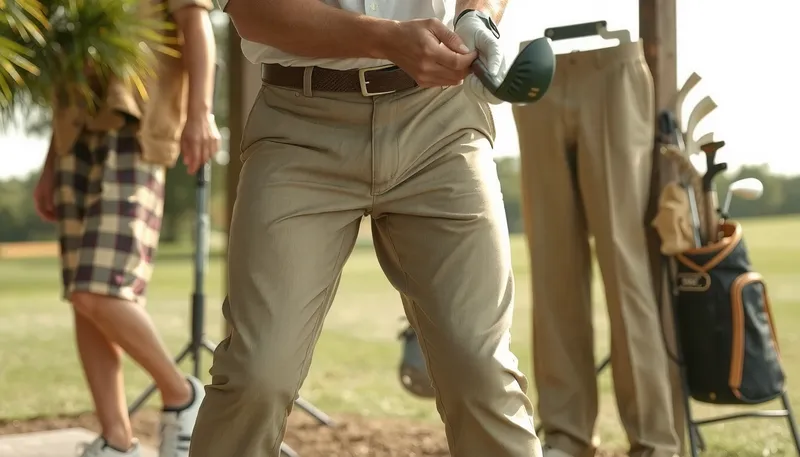
Structured-stretch golf pants fabric is a circular weft-knit air-layer: two knit faces joined by connecting yarns, giving the fabric enough body to hold a tailored line and enough stretch for a golf swing. Scope: knit golf pants fabric, with D083 Air-Sculpt 34™ as the reference platform.
The D083 platform is 66% Nylon 6 (20D/24F) plus 34% spandex (20D), at 170 g/m² and 140 cm, heat-set at 196°C in production. Request its recovery, pilling and moisture behavior as a report with the method and conditions attached. A percentage without conditions is not a specification, because it cannot be compared with another fabric or another laboratory.
The distinction matters because golf pants are usually bought against a tailored appearance, while the fabric is judged in motion. A woven chino holds a crease but restricts the hip and knee. A light single jersey moves freely but can lose shape under repeated strain. An air-layer knit is the middle route, and the only way to know whether a given quality holds that middle is to test the finished fabric.
Three labels mark the basis of a statement in this guide. Standard means the text of a numbered standard. Project data means Forall Lab platform or lab data. Buyer target means a value the buyer sets; no standard sets it.
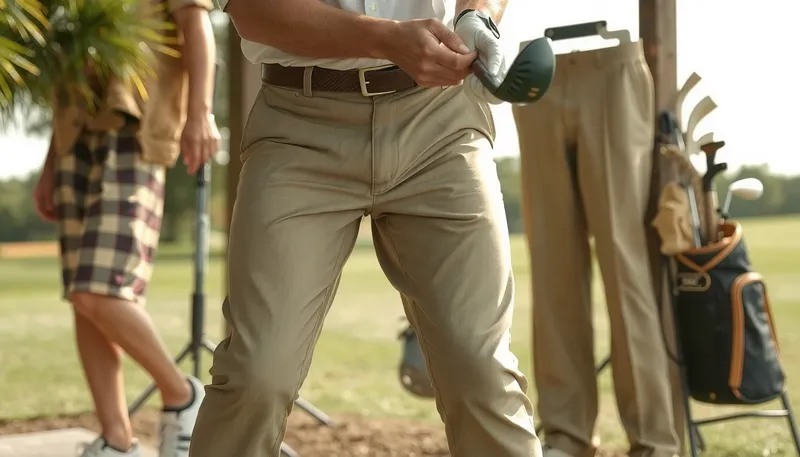
What Fabric Are Golf Pants Made Of?
Performance golf pants are built on one of two base cloths: a stretch woven twill of polyester or nylon, or a knit that carries stretch through its loop structure. Both usually add elastane (spandex) for movement. The percentage states the share, not the force or the recovery.
The D083 platform in this guide is the knit route: a circular weft-knit air-layer of 66% Nylon 6 and 34% spandex at 170 g/m². The fiber list is the starting point. The construction and the test reports decide whether the fabric works for the swing.
Are Golf Pants Just Chinos?
No. In cut and pockets, a golf pant can look like a chino. The base cloth is not the same. A chino is a woven cotton or cotton-blend twill. A performance golf pant is usually a stretch woven or a knit.
Two fabrics can share the outward look and still behave differently at the hip and knee. Appearance does not identify construction. Ask for the construction sheet and the fiber declaration, then test the finished fabric. Without them you are buying a look, not a base cloth.
What Is Air-Layer Structured-Stretch Fabric?
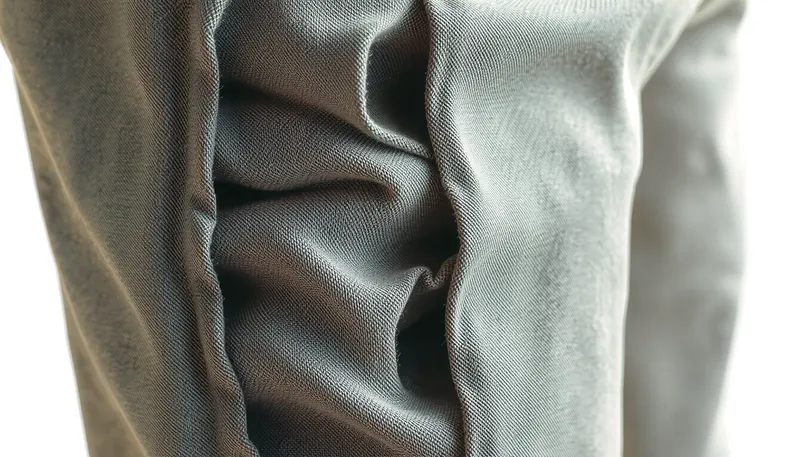
Air-layer fabric is a double-face knit in which two knit surfaces are connected by yarns that cross the gap between them. The structure is knitted as one textile, not bonded or laminated.
The outer face can be finished for abrasion resistance and a clean surface. The inner face can be finished for skin comfort. The connecting yarns create thickness and resilience without a foam or coating layer.
The difference from a plain interlock is the gap. An interlock combines two rib structures into a dense double layer with no air space between the faces. An air-layer keeps connecting yarns spanning that space, and the gap carries part of the body and thickness.
Air layer is a family name, not one structure. A weft-knitting technology reference (《纬编工艺分析与技术》, p. 82) describes two routes. A 2-feed route joins the plain loops with sinker arcs and is easier to unravel. A 4-feed route joins them with floats and is thicker and more stable.
The two routes can share a composition and a weight and still differ at a cut edge, a seam and under extension. The D083 platform data in this guide does not state the route. Ask for the feeder count and the connection type on the construction sheet.
The air-layer is not the warp-knit 3D spacer family, where a separate spacer yarn holds two ground fabrics apart. In this circular knit the connection is made within the same construction.
The air gap is a structural feature, not a permanent one. If the connection is too loose or fatigues in use, the gap collapses, the fabric reads thinner and coverage drops. Ask for thickness retention and compression recovery after the agreed heat and wash route. If breathability is claimed, ask for air permeability (ASTM D737-18(2023)) at a stated pressure drop. Air permeability measures airflow, not thermal comfort.
D083 is a circular weft-knit air-layer. The description is structural, not a sales adjective: the machine is circular, the knitting action is weft, and the fabric has two faces joined in one construction. D083 is not a warp-knit double tricot, and not a bonded laminate.
If a supplier describes a fabric only as "double" or "air-layer" without the machine type and the connecting-yarn configuration, ask for the construction sheet. The word alone does not identify a structure.
The term "golf breeches" still appears in search and in some catalogs, a carryover from equestrian riding breeches. The clothing history is different, but the textile question is the same: the fabric has to follow a moving hip and knee and return to a presentable line.
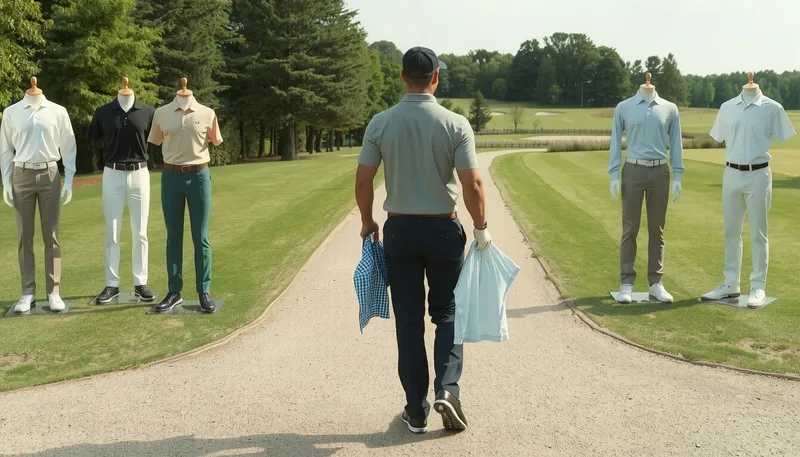
Why Golf Pants Need a Different Fabric
Golf pants need body and stretch in the same cloth, and spandex percentage alone does not deliver both. A golf swing loads the garment in several directions at once. The hip panel rotates, the seat panel stretches, the knee flexes, and the waistband resists.
A woven fabric with little stretch can restrict the turn or concentrate stress at a seam. A very light knit can follow the motion but may not have enough body to keep a crease or a clean line through 18 holes.
The engineering answer is not simply "more spandex." Four variables decide the result:
- Knit structure. An air-layer distributes strain across two faces and the connecting yarns. A single jersey has one face and less thickness.
- Denier and share of spandex. A 20D spandex is a fine filament; a heavier denier carries more polymer per unit length. The percentage tells you the share, not the force.
- Heat setting. The stenter conditions fix residual shrinkage and the fabric's elastic memory. A good fiber can be damaged by a poor setting.
- Garment pattern. A fabric that passes a bench test can still bag if the pattern over-strains the knee or seat panel.
A golf pants specification should therefore name the fabric construction and the test method, not only the fiber content. The same 34% spandex can behave differently in an air-layer and in a single jersey. A fiber-only specification leaves the construction, and the bagging risk, open.
D083 Air-Sculpt: The Platform Data
D083 Air-Sculpt 34™ is the reference platform for this guide. The values below are project data, not a claim that every garment made from it will pass a buyer's target.
| Property | Platform value |
|---|---|
| Composition | 66% Nylon 6 (20D/24F) + 34% spandex (20D) |
| Structure | Circular weft-knit air-layer double knit, faces joined within the construction |
| Air-layer route | Not stated on the platform data; ask for feeder count and connection type |
| Weight | 170 g/m² nominal |
| Usable width | 140 cm |
| Heat setting | 196°C production heat-setting |
| Surface | Mochi Touch nylon face (hand-feel specification; separate pilling report) |
| Certification | OEKO-TEX STANDARD 100; class and product scope per certificate (internal controlled record: Class II) |
| Brand of spandex | Not named on the platform specification |
The 20D/24F figure describes the nylon face yarn: 20 denier, 24 filaments. Twenty denier across 24 filaments is about 0.83 denier per filament, in the microfilament range behind the Mochi Touch hand. The spandex is a separate 20D yarn. Writing "34% elastane on 20D/24F" conflates the two yarns. Avoid it in a purchase order, because the supplier can then satisfy the line with either yarn.
The platform specification does not name a spandex brand. If the brand is a purchase requirement, ask for the fiber manufacturer and lot traceability and put the requirement in the contract. Do not infer a brand from the fabric code or from a hangtag. An inferred brand is unverified and cannot be enforced.
Project data (Forall Lab internal test record, 2025; protocol and raw data on request). Input: n=18 specimens from 3 production batches. Output: 2.8–3.4 N/cm at 30% extension; 91.5% modulus retention after 10,000 extension–release cycles at 30%; 2.1% set after 30 minutes at 50% extension and 30 minutes recovery.
These figures describe fabric fatigue. They are not an ISO 20932-1 recovery percentage, not a pressure and not a wash result. They give a direction for the knee-bagging question. The answer still comes from a garment trial.
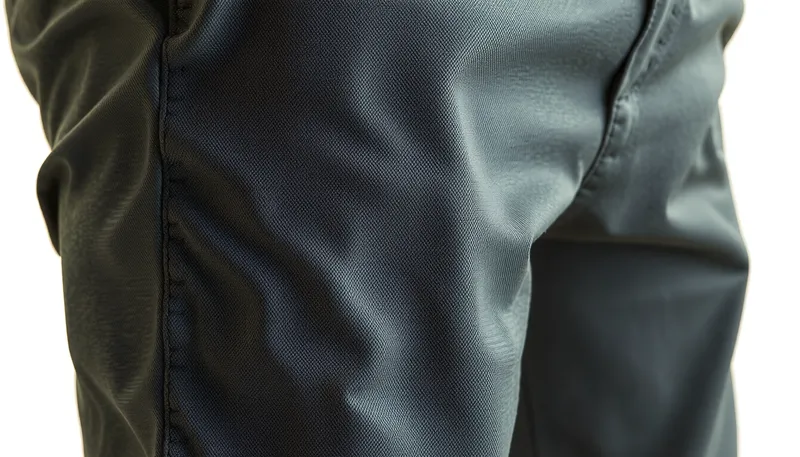
How to Test the Properties That Matter
Request each property as a report that names the method and the conditions. A claim without both cannot be checked, and a grade from one method cannot stand in for a grade from another. The subsections below name the method for each property.
Recovery
For a knit, request ISO 20932-1:2018 with Amendment 1:2021 (standard). The report must state six measurement conditions: extension or load, hold time, cycle count, recovery read time, specimen width and test direction. The purchase order also names the method, specimen type and extension rate, because those identify the test. Without all of them, the percentage cannot be compared with another fabric or another laboratory.
Three common misapplications appear in golf fabric datasheets:
- ASTM D3107 is for woven stretch fabrics. It is not a knit recovery method and should not be used for an air-layer. A D3107 number on a knit is a woven-method result on the wrong fabric.
- ASTM D2594/D2594M-21 is for low-power knits and reports stretch and growth, not a recovery percentage. The standard states that it is not recommended for acceptance testing of commercial shipments because of between-laboratory precision, so a D2594 figure should not be used to rank two mills.
- ASTM D4964-96(2020) measures tension and elongation in the extending cycle. It does not report a recovery percentage.
If a mill runs an internal static-hold protocol instead, ask for the full protocol: load, hold time, read time, number of specimens and specimen dimensions. Label the result as internal, not as an ISO or ASTM result.
How much the number moves when the conditions change is fabric-specific and must be measured on the actual quality. Do not borrow a range from another report. The range belongs to that fabric, not to yours.
What can be shown without a new test is the arithmetic of the reported basis.
Growth (calculated) = extension × (1 − recovery). Applies to the reported basis only; it is arithmetic, not a measurement.
At a recovery of 95%, the calculated growth is 4% at an 80% working extension and 5% at 100%. The fabric is the same; the test is not. A longer hold or more cycles can also move the measured recovery, and the size and direction of that change must be measured per lot.
Pilling
For D083, request ISO 12945-2:2020, the modified Martindale method (standard), with the number of rubs, the applied pressure and the assessment conditions stated. Pilling grades are method-specific. A Grade 4 from ASTM D3512 random tumble is not interchangeable with a Grade 4 from ISO 12945-2, because the abrasion action and the rating scale differ.
A Grade 4 pilling specification is a buyer target for golf pants, not a platform guarantee. Ask for the report on the actual shade and finish, because brushing, dyeing and softening can change the surface.
A Grade 4 listing for the base platform does not automatically cover the Mochi Touch or True Matte surface options. Each surface needs its own pilling report. True Matte is a full-dull, in-polymer matte rather than a coating. Mochi Touch is a hand-feel specification built from sub-1.0 DPF microfilaments, not a coating. A claim about the surface must be supported by a report for that surface.
Moisture Management and Wicking
Two AATCC methods are often confused, and they do not measure the same thing:
- AATCC TM195 measures liquid moisture management: wetting time, absorption rate, spreading speed and related metrics on the fabric surface.
- AATCC TM197 measures vertical wicking on a 25 mm strip, with readings typically taken at 1, 5 and 10 minutes.
A height claim and a rate claim are different metrics. TM197 reports vertical wicking height on the strip, while AATCC TM213 reports wicking rate at specified times. State which one the buyer target refers to.
A claim of "5 cm vertical rise" belongs to a vertical wicking test, not to TM195. Neither method sets a universal pass line. A buyer target such as a wetting time or a wicking height must be stated with the method and the reading time, or the supplier and the buyer will read different numbers.
Color Fastness and Phenolic Yellowing
For wash color fastness, specify ISO 105-C06 with the test severity and the color change / staining requirement. Grade 4-5 is a buyer target, not a standard pass line for every color.
For white and light shades, ISO 105-X18:2007 screens for phenolic yellowing associated with packaging and storage. It is a screening method, not proof that an anti-yellowing treatment will last through the garment's life. The D083 platform is positioned for anti-yellowing. Verify the claim with a current report for the specific shade, packaging film and storage condition.
Golf Adds Sweat, Sun and Abrasion
Golf adds three conditions that a recovery report does not cover: sweat, sunlight and abrasion. Ask for color fastness to perspiration (ISO 105-E04:2013) and to artificial light (ISO 105-B02:2014) per color. Ask for abrasion (ISO 12947-2:2016, confirmed 2023) reported as cycles to specimen breakdown.
None of these standards sets a universal pass line. State the buyer target for each, per color.
If the program needs rain protection, the D083 platform data does not list a DWR. Specify the finish and request an after-wash AATCC 22 or ISO 4920:2012 rating, then re-check hand and air permeability. A rating taken before wash does not describe the garment after care.
What to Put on the Purchase Order
A golf pants fabric specification should be short enough to check and complete enough to test. The table separates platform values from buyer targets.
| Item | What to write | What to attach |
|---|---|---|
| Composition | 66% Nylon 6 + 34% spandex; face yarn 20D/24F; spandex 20D | Fiber declaration and construction sheet |
| Structure | Circular weft-knit air-layer, two faces joined by connecting yarns | Machine type, feeder count and connecting-yarn description |
| Weight / width | 170 g/m² nominal; 140 cm usable | Test method for weight and a measured sample; marker for the largest size |
| Recovery | Buyer target in % with extension, hold, cycles and read time | ISO 20932-1:2018 report |
| Pilling | Buyer target grade with rub count and pressure | ISO 12945-2:2020 report for the actual surface |
| Wicking | Buyer target with method and reading time | AATCC TM195, TM197 or TM213 report |
| Color fastness | Buyer target grade with test severity | ISO 105-C06 report per color |
| Service conditions | Buyer targets for perspiration, light and abrasion, per color | ISO 105-E04, ISO 105-B02 and ISO 12947-2 reports |
| Certification | OEKO-TEX STANDARD 100; class and scope per certificate | Certificate number and Label Check result |
The Recovery Clause to Attach to the PO
Copy this list into the purchase order or its technical annex. Each line is a field to be filled, not a description to be agreed.
- Method: ISO 20932-1:2018 with Amendment 1:2021.
- Specimen type: strip or loop.
- Extension and retraction rate: 500 mm/min for knits under clause 9.2; a report run at 100 mm/min belongs to the 9.1 woven route.
- Extension or load: state the value and unit.
- Hold time: state in seconds.
- Cycles: state the count.
- Recovery read time: state the interval after unloading.
- Specimen width: state in millimeters.
- Direction: wale or course.
The purchase order should also state the color, the finish, the garment end use and the country of sale. A certificate or test report that does not match those four items is not evidence for the order.
Golf Fabric Claims That Need a Second Document
A sales sheet can name a property without saying how it was measured. The table turns common golf-fabric claims into the document that can support them.
| Claim on the sheet | What the report must state | Document to request |
|---|---|---|
| 4-way stretch | Stretch and recovery in wale and course separately, with extension or load, cycles and read time | ISO 20932-1:2018 report |
| "95% recovery" | The six ISO 20932-1 conditions; without them the figure is not comparable | ISO 20932-1:2018 report, not ASTM D3107 |
| Grade 4 anti-pilling | Method, rub count, pressure and assessment conditions | ISO 12945-2:2020 report for the actual shade and surface |
| Moisture-wicking | Which metric (wetting time, spreading speed, vertical rise or wicking rate) and the reading time | AATCC TM195, TM197 or TM213 report |
| UPF 50+ | Test method, specimen preparation and label classification rule | AATCC TM183 report; grade classified per ASTM D6603 |
| "Cooling" or "breathable" | Method and conditions; there is no universal pass line | A named test and its protocol; ASTM D737-18(2023) for air permeability |
| OEKO-TEX certified | Article, product class, scope and validity | Certificate plus Label Check |
| Anti-yellowing | Shade, packaging film and storage condition tested | ISO 105-X18:2007 report |
| Abrasion resistance | Cycles to specimen breakdown at the stated conditions | ISO 12947-2:2016 report |
| Sweat fastness | Test severity and color change / staining grade, per color | ISO 105-E04:2013 report |
| Light fastness | Exposure method and grade, per color | ISO 105-B02:2014 report |
| Water repellent | Finish, wash program and spray rating | AATCC 22 or ISO 4920:2012 report after wash |
Why a Per-Yard Price Is Not a Per-Kilo Price
A per-yard quote and a per-kilo quote cannot be compared until both are converted to the same unit. Retail and trading quotes use linear yards. Mill quotes use kilograms.
Mass per linear yard (kg) = g/m² × width in meters × 0.9144 ÷ 1000. Applies to a quote based on one stated width.
At 170 g/m² and 140 cm usable width, one linear yard is about 0.218 kg, and 1 kg is about 4.6 linear yards. Use the width the quote is based on, and state whether it is usable width or full width. A quote on full width and a quote on usable width are different numbers, and mixing them shifts the price per kilo.
MOQ, lead time and price are order-specific and are not part of the platform data. This guide covers fabric specification, not commercial terms. Ask for the current MOQ by color and finish, and see our fabric lead-time guide for the greige versus custom-knitting route.
Limitations and Care
Air-layer golf pants are not a universal replacement for every trouser. Five limits should be settled before a program is committed:
- Formal dress codes. A knit cannot reproduce the razor-sharp crease of a worsted woven. If the buyer's dress code requires a pressed military crease, an air-layer is the wrong base cloth.
- Cold weather. At 170 g/m², D083 is a three-season golf fabric. It is not a winter trouser on its own. A thermal base layer or a heavier platform is the appropriate route.
- Deep squat and seam grin. A very deep squat can open the seam line enough to expose the inner face. This is a fit and pattern issue as much as a fabric issue, so prototype the garment in the intended size range. A seam that is stiffer than the fabric creates a ridge and concentrates strain. Ask for seam strength and seam extension on the actual seam type, plus the sewing record: needle type, machine speed and any heat applied. A hot needle can fuse spandex-rich knits. Seam methods written for woven fabrics, such as ASTM D1683 (seam strength) or ISO 13936-2 (yarn slippage at a seam), are not a default knit method. Have the lab name the method it will use.
- Opacity under stretch. Opacity is a separate buyer protocol: test at the working extension, under D65, after the agreed wash, and set the acceptance with the buyer. There is no universal pass line.
- Panel layout at 140 cm. At 140 cm usable width, a large-size leg panel may not fit without a body seam. Ask for the marker and check where that seam lands at the knee and seat before approving the pattern.
The care label decides the wash and finishing program, not the fiber type. Follow the care label and the fiber supplier's technical data sheet.
At fiber level, textile materials references put spandex softening at 175–200°C and note that sustained exposure above about 150°C can yellow, tackify and lose strength. These are fiber-level figures, not a D083 test result. The 196°C setting figure is a temperature, not an exposure. Ask for the dwell time, overfeed and tension used at the stenter. Do not treat a domestic iron at the same temperature as equivalent.
High dryer temperatures and hot ironing can reduce recovery. Follow the care label on fabric softener; do not add it unless the label permits it. Do not treat a single wash trial as proof of a garment's service life. Define the wash cycles and the measurement points before the trial.
Sourcing Checklist
Before approving a golf pants fabric, ask for six documents:
- A construction sheet naming the machine type, the feeder count and the connecting-yarn structure.
- An ISO 20932-1 recovery report with all six conditions.
- An ISO 12945-2 pilling report for the actual shade and finish.
- A moisture-management report using AATCC TM195, TM197 or TM213, with the metric and reading time stated.
- An OEKO-TEX STANDARD 100 certificate whose class and product scope cover the fabric and the intended end use.
- A service-condition pack: perspiration (ISO 105-E04) and light (ISO 105-B02) per color, abrasion (ISO 12947-2) to specimen breakdown, and an after-wash DWR report if rain protection is specified.
If any document is missing, the claim is unverified. A sales sheet can describe the fabric. Only a report with conditions can support a performance claim.
Frequently Asked Questions
What is air-layer fabric?
Air-layer fabric is a double-face knit in which two knit surfaces are joined by connecting yarns. It is knitted as one textile, not bonded or laminated. The structure gives more body and thickness than a single jersey while retaining knit stretch. In golf pants, the outer face carries the tailored appearance and the inner face carries skin comfort.
Is D083 suitable for golf pants?
D083 is a circular weft-knit air-layer at 170 g/m², with 66% Nylon 6 (20D/24F) and 34% spandex (20D). It is a plausible base cloth for three-season golf pants when the garment is patterned for the swing and the buyer's recovery, pilling and wicking targets are confirmed by report. It is not a winter fabric on its own, and it is not a substitute for a formal worsted trouser.
Does 34% spandex guarantee that the knees will not bag?
No. The spandex percentage is one variable. Bagging depends on the knit structure, the spandex denier, the heat setting, the garment pattern and the wear cycle. Ask for the platform fatigue data, a recovery report with the full test conditions, and a garment trial that includes sitting, squatting and walking. A percentage on a label cannot answer the bagging question by itself.
Which recovery test should I request for a knit golf fabric?
Request ISO 20932-1:2018 with Amendment 1:2021 for a knit. The method name is not enough: the report must carry the six measurement conditions, or the number cannot be compared. ASTM D3107 is woven-only. ASTM D4964 reports tension and elongation, not recovery.
Is ASTM D3512 the right pilling test for D083?
ASTM D3512 is a random-tumble pilling method. For D083, ISO 12945-2:2020 is the method used in the platform's current documentation. The two methods use different abrasion actions and rating scales, so a grade from one cannot be substituted for the other. State the method, rub count and pressure in the purchase order.
Is AATCC TM195 the same as vertical wicking?
No. AATCC TM195 measures liquid moisture management metrics such as wetting time and spreading speed. AATCC TM197 measures vertical wicking on a 25 mm strip, usually read at 1, 5 and 10 minutes. A 5 cm vertical rise claim should cite TM197, not TM195.
How should D083 golf pants be washed?
The care label decides the program, not the fiber type. Follow the care label and the fiber supplier's technical data sheet. High dryer heat can reduce recovery, and softener should be used only if the label permits it. Define the wash cycles and measurement points before treating a trial as evidence of service life.
Is OEKO-TEX Class II automatic for D083?
No. OEKO-TEX STANDARD 100 certifies a specific article within a stated product class and scope. For D083, the internal controlled record lists Class II, the usual class for adult next-to-skin articles, but the certificate for the specific fabric and color is the authority. Do not infer the class from the platform name or from a sales sheet.
What fabric are golf pants made of?
Golf pants in the performance segment are commonly built on a stretch woven twill of polyester or nylon with elastane, or on a knit with elastane. Chinos are woven cotton twill. D083 is the knit route: a circular weft-knit air-layer of 66% Nylon 6 (20D/24F) and 34% spandex (20D) at 170 g/m². The fiber list is the starting point; the construction and the test reports decide whether the fabric works for the swing.
Are golf pants just chinos?
No. A chino is a woven cotton or cotton-blend twill. A performance golf pant is usually a stretch woven or a knit, and the two can look alike while behaving differently at the hip and knee. Ask for the construction sheet and the fiber declaration before assuming the base cloth.
Why do two recovery reports for the same fabric show different numbers?
Because the reported basis can differ even when the fabric does not. A recovery value is only comparable when the method, specimen type, extension or load, hold time, cycle count, read time, width and direction are the same. As arithmetic, at 95% recovery the calculated growth is 4% at an 80% working extension and 5% at 100%; the conditions moved the number, not the fabric. Hold time and cycle count can also change the measured result, and the size of that change must be measured on the actual quality.
About the Author
Wenruo is a fabric development engineer at Forall Lab, working with nylon/spandex knits for activewear, swimwear and seamless programs. She writes about fabric specification, testing and mill-floor problem solving, translating mill data into decisions that brand teams can act on. Her work focuses on the gap between lab results and bulk production.
This guide uses the D083 platform data and the test-method boundaries stated above. It does not report a new golf wear trial; request the current fabric reports for the program you are sourcing.
Contact our fabric engineering team →
🔗 Related Fabrics
Golf Pants Fabric — Structure and Testing Resources
- D083 Air-Sculpt 34™ Product Page — full platform specs, 170 g/m² at 140 cm, and certification documentation
- Brushed Nylon Spandex Fabric: D083 Surface Variants — the same D083 substrate with a different surface finish; pilling and hand-feel depend on the finishing route
- Double Jersey Interlock Fabric: The Definitive Buyer Guide — the same double-face appearance with a different construction; "double" is not a structure judgment
- How to Test Fabric Stretch Recovery — knit recovery conditions, growth versus recovery, and the ASTM D3107 woven boundary
- Fabric Grin-Through: Opacity Under Stretch — why a deep squat and a stretched knit expose the inner face, and how to set an opacity protocol
- Fabric Lead Time from China: Greige vs Custom Knitting — the commercial terms this guide does not set: the greige versus custom-knitting route and what drives lead time
- Back to Fabric Index
Written by Wenruo
Textile Engineer, Forall Lab