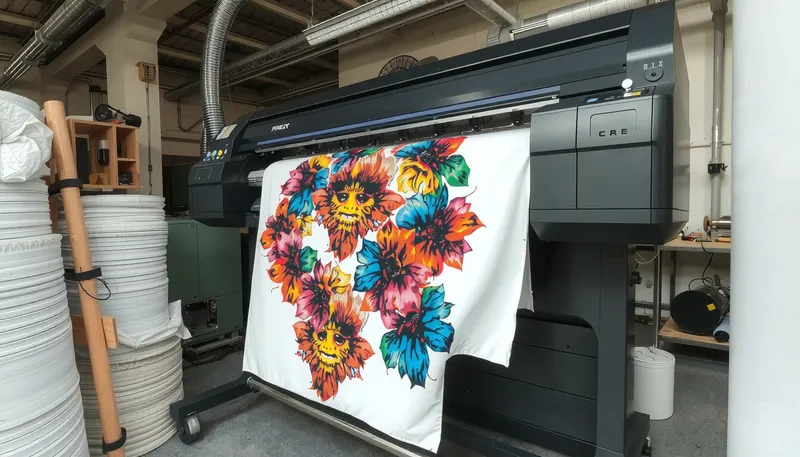
Acid digital printing on nylon spandex requires four stages: pre-treatment padding at pH 4.5–5.5 to control ink bleed, piezoelectric inkjet deposition at 600–1200 DPI, steaming at 102°C for 8–12 minutes to fix dye via ionic bonding (Dye⁻ + ⁺H₃N-Fiber), and wash-off of <5% unfixed dye. On a stable interlock substrate, the process achieves ISO 105-C06 C2S Grade 4-5 wash fastness and ISO 105-X12 Grade 4+ crocking fastness. This article covers process control parameters — for acid printing chemistry and grin-through elimination, see Nylon Acid Digital Printing.
Searching for "digital printing on nylon spandex"? That phrase spans three technologies, and only one is wash-durable on nylon — which is why this guide, and its sister comparison, focus on acid dye. Sublimation (disperse dye) has no chemical affinity for polyamide: on nylon it sits on the fiber surface and fades within 5-10 home washes, so the polyester sublimation suppliers you find under the broad term cannot print your nylon durably. Pigment with a binder works on low-nylon blends but caps at Grade 3-4 wash fastness. Acid dye printing forms an ionic bond with nylon's amine groups during 102°C steaming and reaches ISO 105-C06 Grade 4-5 — the process this guide documents stage by stage. To weigh acid against sublimation for your product tier before committing to a process, start with our acid printing vs. sublimation comparison.
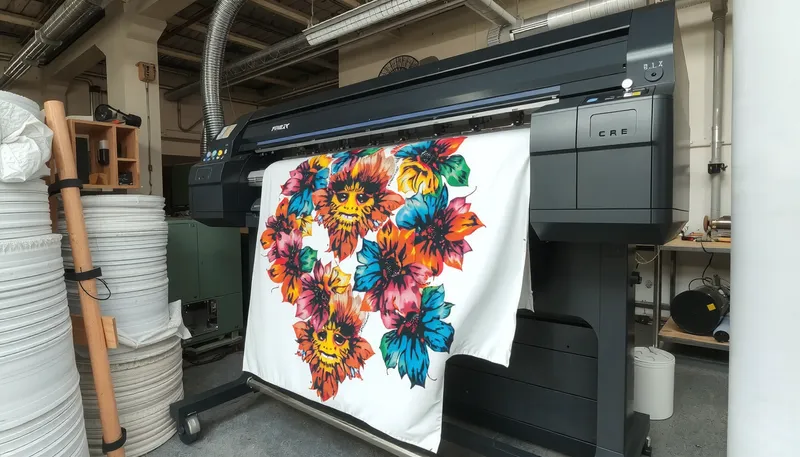
Why Nylon Resists Sharp Digital Printing: Three Root Causes
Nylon resists sharp digital printing due to three inherent fiber properties: hydrophobicity — water-based ink beads on the non-porous polyamide surface instead of absorbing; low surface energy (<36 mN/m vs cotton's >70 mN/m) — ink droplets contract into spheres rather than spreading; and heat sensitivity — nylon's softening point of ~180°C limits curing temperature, unlike polyester's 260°C tolerance. Pre-treatment addresses all three simultaneously by depositing a cationic receptor layer that increases surface energy, controls pH, and encapsulates fibers for thermal protection.
Hydrophobicity: Ink Beading on Nylon
Nylon 6 and Nylon 66 are polyamides with moisture regain of 4.0-4.5% — half of cotton's 8.5%. Water-based acid dye ink, when jetted onto untreated nylon, sits on the fiber surface rather than penetrating the polymer structure. The result: ink coalesces into larger droplets before drying, producing fuzzy line edges and a loss of fine detail below 0.5 mm line width.
Low Surface Energy: Why Ink Won't Spread
Surface energy determines how a liquid wets a solid. Cotton's surface energy exceeds 70 mN/m — well above water's 72.8 mN/m surface tension, so ink spreads readily. Nylon registers below 36 mN/m in its untreated state. The ink droplet maintains a high contact angle (>90°), minimizing its footprint on the fabric. This is the same physics that makes water bead on a waxed surface — but on nylon, it destroys print registration.
Heat Sensitivity: The Temperature Ceiling
Polyester tolerates dry-heat curing at 180-210°C. Nylon begins softening at 170-180°C and melts at 215-255°C depending on polymer grade. This thermal ceiling eliminates dry-heat fixation as a curing method, pushing the process toward saturated steam (102°C) — which transfers heat more gently and uniformly through latent heat of condensation rather than direct thermal conduction.
The Solution in One Step
A single pre-treatment padding step neutralizes all three barriers:
| Barrier | Mechanism | Pre-Treatment Solution |
|---|---|---|
| Hydrophobicity | Ink beads, no absorption | Cationic receptor layer increases surface polarity |
| Low surface energy | High contact angle, no spread | Acidic padding (pH 4.5–5.5) lowers ink surface tension |
| Heat sensitivity | Cannot dry-cure above 180°C | Encapsulation enables 102°C saturated steam fixation |
Pre-Treatment Chemistry: pH Control and the D036 Substrate
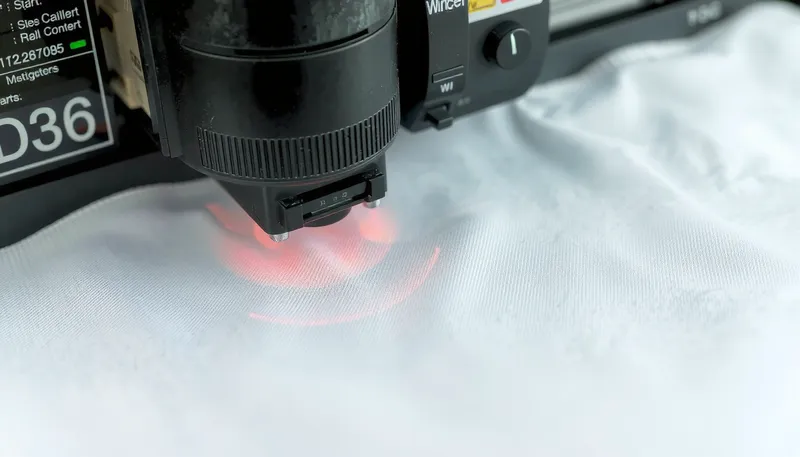
Pre-treatment for acid digital printing consists of padding nylon fabric through an aqueous solution at pH 4.5–5.5 containing acid dye fixation agents and anti-bleed polymers. The solution is not "D036" — D036 is the fabric substrate: 76% Nylon (40D/34F) / 24% Spandex (40D), interlock knit (锦氨双经平, 一开一闭), 160 g/m², width 155 cm. The interlock structure provides dimensional stability through pre-treatment wetting, printing, steaming, and wash-off — preventing the edge curl that distorts print registration on single jersey fabrics. For acid printing chemistry fundamentals.
Pre-Treatment Solution Components
| Component | Function | Target Parameter |
|---|---|---|
| Acid dye fixation agent (cationic polymer) | Creates positively charged receptor sites on fiber surface | 10–30 g/L depending on fabric weight |
| pH buffer (acetic acid / ammonium sulfate) | Maintains pH 4.5–5.5 for optimal dye uptake | pH meter verification before each batch |
| Anti-bleed agent (alginate thickener) | Controls ink droplet spread, maintains edge definition | Viscosity 200–400 cP at 25°C |
| Wetting agent (non-ionic surfactant) | Reduces surface tension for even solution penetration | 1–3 g/L |
| Urea (humectant) | Retains moisture during steaming for dye migration into fiber | 50–100 g/L |
D036: The Substrate, Not the Pre-Treatment
A common misconception conflates the fabric base with the chemical pre-treatment. The two are distinct:
| Element | What It Is | Role in Print Quality |
|---|---|---|
| D036 substrate | 76% Nylon (40D/34F) / 24% Spandex (40D), interlock knit, 160 g/m², 155 cm width | Provides ≥76% amine sites for dye bonding; interlock prevents curling; dimensional stability through multi-stage wet processing |
| Pre-treatment solution | pH 4.5–5.5 aqueous padding liquor with cationic fixation agents | Increases surface energy; controls ink bleed; optimizes dye uptake kinetics |
The D036 interlock construction (锦氨双经平, 一开一闭) is critical: single jersey fabrics curl at the edges when wetted during pre-treatment, distorting print registration. Interlock's balanced face-and-back structure maintains flatness through all four process stages, producing <0.5 mm print distortion across the full 155 cm fabric width.
Application Parameters
| Parameter | Specification | Tolerance |
|---|---|---|
| Padding method | Two-roll vertical padder, 2-dip-2-nip | — |
| Solution temperature | 25–30°C | ±2°C |
| Pickup rate | 70–80% (owf) | ±5% |
| Drying temperature | 100–120°C | ±5°C |
| Drying method | Tenter frame with controlled overfeed | ≤2% width loss |
| Residual moisture after drying | 6–8% | ±1% |
Drying at temperatures above 120°C risks premature dye fixation in the pre-treatment layer — forming a surface crust that blocks steam penetration during the fixation stage. Below 100°C, incomplete drying leaves moisture gradients that produce uneven color depth across the fabric width.
Equipment Selection: Printheads, Steamer, and Tension Control
Three equipment decisions determine acid digital print quality: printhead technology — piezoelectric drop-on-demand (Kyocera KJ4B or Epson PrecisionCore) at 600–1200 DPI, not thermal inkjet which degrades heat-sensitive acid dyes; steamer type — continuous saturated-steam steamer maintaining 102°C ±1°C with uniform steam distribution across the full fabric width; and fabric transport — belt-driven feed with tension control ≤2 N/cm to prevent stretch-induced print distortion on spandex blends. Each component interacts with the others; a high-DPI printhead on a poorly tensioned feed produces distorted high-resolution output.
Printhead Selection: Why Piezoelectric
Acid dyes degrade at the 300°C+ temperatures generated by thermal inkjet nozzles. Piezoelectric printheads use mechanical crystal deformation to eject droplets — no heat applied to the ink. Key specifications:
| Printhead Model | Technology | Resolution | Drop Volume | Suitability |
|---|---|---|---|---|
| Kyocera KJ4B | Piezoelectric | 600–1200 DPI | 4–14 pL | High-volume production, 8-color process |
| Epson PrecisionCore | Piezoelectric | 600–1200 DPI | 3–12 pL | Small-to-mid volume, 4–6 color process |
| Ricoh GEN5 | Piezoelectric | 600 DPI | 7–21 pL | Economy option; larger drop volume limits fine detail |
Drop volume directly affects print sharpness: <7 pL produces line widths below 0.3 mm; >14 pL creates visible dot gain and color bleeding between adjacent printed areas. For activewear graphics with text and fine geometric patterns, specify ≤10 pL drop volume.
Steaming Parameters
The steamer is the most process-critical equipment component. Under-spec steaming produces Grade 2-3 wash fastness even with correct pre-treatment and printing:
| Parameter | Specification | Consequence of Deviation |
|---|---|---|
| Temperature | 102°C (saturated steam at atmospheric pressure) | <100°C: incomplete dye fixation; >105°C: fiber damage, spandex degradation |
| Steam saturation | 100% RH, no superheat | Dry steam: <50% dye fixation rate; wet steam: color bleeding, pattern blur |
| Residence time | 8–12 minutes | <6 min: <80% dye fixation; >15 min: spandex heat aging, 10-15% recovery loss |
| Fabric path | Single-pass, no contact with chamber walls | Wall contact: scorch marks, local over-cure, color variation ±2 dE |
Tension Control for Spandex Blends
Nylon spandex fabrics stretch under tension during web transport. If the fabric enters the print zone under ≥5 N/cm tension, the printed image contracts when tension releases — producing geometric distortion of 2-5% in the weft direction. Belt-driven feed systems with vacuum hold-down maintain tension at ≤2 N/cm, limiting post-print contraction to <1%.
The Four-Stage Process: Pre-Treat → Print → Steam → Wash
The acid digital print process follows a strict sequence: (1) pre-treatment padding at pH 4.5–5.5, dried to 6-8% residual moisture at 100–120°C; (2) piezoelectric inkjet printing at 600–1200 DPI with acid dye inks, fabric tension ≤2 N/cm; (3) saturated steam fixation at 102°C for 8–12 minutes to form the ionic dye-fiber bond; (4) cold-water rinse followed by warm wash at 40–50°C to remove <5% unfixed dye and residual pre-treatment chemicals, then drying at ≤60°C. Each stage depends on the output of the previous stage — a pH error in stage 1 propagates through all subsequent stages.
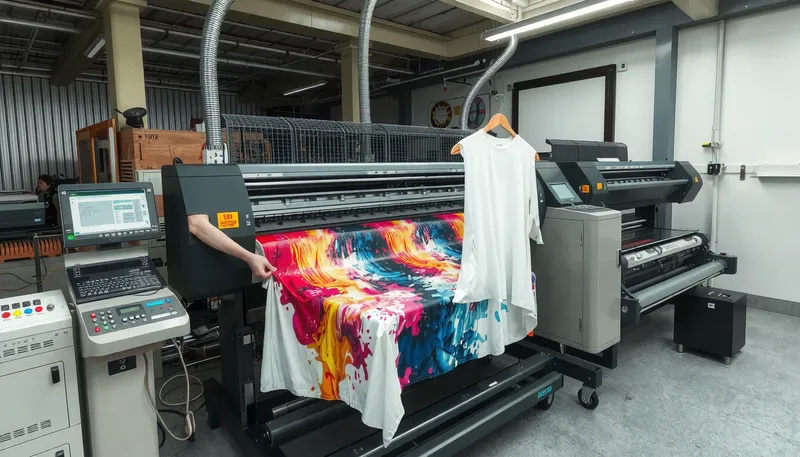
Stage 1: Pre-Treatment Padding
Load the fabric onto the padder at constant tension. Immerse through two dips in the pH 4.5–5.5 pre-treatment bath, squeeze through two nips to 70–80% pickup (owf), then dry on a tenter frame at 100–120°C to 6–8% residual moisture. Verify pickup rate by weighing a 10×10 cm swatch before and after padding. Verify pH of the bath with a calibrated meter — not test strips, which lack the ±0.2 pH precision required.
Stage 2: Digital Printing
Load the dried, pre-treated fabric onto the printer feed belt. Verify belt adhesion — the fabric must lie flat with no wrinkles, bubbles, or lifted edges. Print at 600–1200 DPI depending on design complexity: 600 DPI for solid color blocks, 1200 DPI for text and fine line work below 1 mm width. Monitor the first meter of output for ink bleed (visible as fuzzy edges or color halo around printed areas) — if present, increase anti-bleed agent concentration by 5 g/L in the pre-treatment bath.
Stage 3: Steam Fixation
This is the non-negotiable stage. During saturated steaming at 102°C, three things happen simultaneously:
- Fiber swelling: Moisture and heat open the nylon polymer structure, creating pathways for dye molecules to migrate from the surface pre-treatment layer into the fiber interior.
- Ionic bonding: The anionic acid dye (Dye⁻) diffuses to cationic amine sites (⁺H₃N-Fiber) on the nylon chain and forms a permanent ionic bond: Dye⁻ + ⁺H₃N-Fiber → Dye⁻···⁺H₃N-Fiber.
- Pre-treatment release: The cationic polymer coating, having delivered the dye to the fiber surface, releases and dissolves in the condensed steam — ready for removal in stage 4.
Skip this stage and the dye remains on the fabric surface as a water-soluble deposit. One home wash cycle removes 60-80% of the color. Five washes leave a faded ghost of the original print — Grade 1-2 on the ISO 105-C06 Grey Scale.
Stage 4: Wash-Off and Drying
Rinse in cold water (<25°C) to shock and remove the pre-treatment polymer residue. Follow with a warm wash at 40–50°C using 1–2 g/L non-ionic detergent to remove unfixed dye (target <5% fixation loss). Final rinse in cold water until conductivity of the rinse water matches the input water — indicating all chemicals have been removed. Dry at ≤60°C on a tenter frame or flat bed dryer. Higher drying temperatures risk thermal migration of any residual unfixed dye, producing a "halo" stain on adjacent unprinted areas.
Process Variable Interaction Table
| Variable | Stage 1: Pre-Treat | Stage 2: Print | Stage 3: Steam | Stage 4: Wash |
|---|---|---|---|---|
| pH | 4.5–5.5 → controls dye uptake | Ink jetting unaffected by pH | Low pH accelerates fixation | Neutral pH detergent only |
| Temperature | 100–120°C drying | 25–30°C ambient | 102°C saturated | ≤60°C drying |
| Time | 2–3 min padding | Print-speed dependent | 8–12 min | 15–20 min total |
| Tension | <5 N/cm during drying | ≤2 N/cm in print zone | Tension-free (festoon) | <5 N/cm on tenter |
| Critical failure | pH >6.0 → Grade 2 wash fastness | Tension >5 N/cm → 3-5% distortion | <6 min → <80% fixation | >60°C drying → halo stain |
QC Implementation: Wash Fastness, Crocking, and Color Accuracy
Post-print QC for acid digital printing on nylon requires three test standards as minimum: ISO 105-C06 C2S (60°C, 30 min, 25 steel balls, ECE detergent) for wash fastness — target Grade 4-5 for both color change and cross-staining on multifiber adjacent fabric; ISO 105-X12 for crocking/rub fastness — target Grade 4+ dry and Grade 3-4 wet; and ISO 105-J03 (CIE L*a*b*, D65/10°) for color difference measurement — target dE <1.0 between the approved lab strike-off and bulk production samples. see full Delta E and dye-lot control methodology.
Three-Test QC Protocol
| Test Standard | What It Measures | Test Conditions | Pass Threshold | Frequency |
|---|---|---|---|---|
| ISO 105-C06 C2S | Wash fastness: color change + cross-staining | 60°C × 30 min, 25 steel balls, ECE detergent | Grade 4-5 (both change and staining) | Every dye lot |
| ISO 105-X12 | Crocking: dry rub + wet rub | 9 N force, 10 cycles, standard crock cloth | Grade 4+ dry, Grade 3-4 wet | Every production batch |
| ISO 105-J03 | Color difference vs approved standard | D65 illuminant, 10° observer, d/8° sphere | dE <1.0 | Every 500m of production |
Factory Validation Data
Across 15,000m of acid-printed D036 production at the Forall mill (May 2026 sampling, n=50 specimens per colorway), ISO 105-C06 C2S results consistently achieved:
- Color change: Grade 4-5 (96% of specimens at Grade 4-5; 4% at Grade 4)
- Cross-staining: Grade 4-5 on all six multifiber types (cotton, nylon, polyester, acrylic, wool, acetate)
- Crocking dry: Grade 4-5 (100% of specimens)
- Crocking wet: Grade 4 (92%) / Grade 3-4 (8%)
This performance uses GOTS-certified acid dyes with OEKO-TEX Eco Passport certification, meeting ZDHC MRSL Level 3 requirements for wastewater discharge.
QC Sampling Protocol
Sample 1 linear meter from the beginning, middle, and end of each production roll. Test all three specimens independently. If any specimen fails (dE >1.0 or fastness <Grade 4), quarantine the affected roll segment and test the adjacent meter on both sides to define the defect boundary. Record dye-lot number, steamer temperature log, and pre-treatment bath pH for root cause analysis.
When Acid Printing on Nylon Fails: Limitations
Three scenarios require adjusting expectations for acid digital printing on nylon: substrate nylon content below 50% — fewer amine binding sites reduce dye fixation to 60-70% of normal, producing Grade 2-3 wash fastness; recycled nylon (Econyl) — base-color variability from post-consumer feedstock makes dE <1.0 on light/pastel shades difficult, accept dE <1.5 for L* >70; and spandex content above 30% — undyed spandex yarns become visible through the print (grin-through), requiring a higher-opacity ink deposit or a pre-dyed spandex yarn specification. For grin-through elimination strategies.
When to Choose a Different Printing Method
| Scenario | Acid Digital Print Result | Recommended Alternative |
|---|---|---|
| <50% nylon content | Grade 2-3 wash fastness, patchy color | Pigment print with binder (Grade 3-4 achievable) |
| 100% polyester substrate | No ionic bond possible — acid dyes have zero affinity for polyester | Dye sublimation at 180–210°C (Grade 4-5 wash fastness) |
| Swimwear requiring chlorine resistance | Acid print achieves Grade 4-5 wash fastness but requires separate ISO 105-E03 chlorine test | Add ISO 105-E03 to QC protocol; specify chlorine-resistant acid dye subset |
| Economy market, cost-driven | Acid print adds 15-20% cost vs sublimation due to pre-treatment + steaming + wash-off | Sublimation for polyester; pigment for nylon blends |
Acid digital printing's 8–12 minute steam fixation step adds both time and equipment cost compared to dry-heat sublimation (3-5 minutes at 180-210°C). The trade-off is justified when the end product requires >20 home wash cycles without visible fade — activewear, swimwear, and performance uniforms where color longevity determines the product's usable life.
FAQ
Is D036 a pre-treatment chemical or a fabric?
D036 is a fabric — 76% Nylon (40D/34F) / 24% Spandex (40D), interlock knit (锦氨双经平, 一开一闭), 160 g/m², width 155 cm. It is the substrate onto which acid digital printing is performed. The pre-treatment is a separate aqueous solution at pH 4.5–5.5 containing cationic fixation agents, anti-bleed polymers, and wetting agents — padded onto the D036 fabric before printing.
What is the difference between acid digital printing and sublimation on nylon?
Acid digital printing uses anionic dyes that form ionic bonds with nylon's amine groups during 102°C steaming — producing ISO 105-C06 Grade 4-5 wash fastness. Sublimation uses disperse dyes that have no chemical affinity for nylon — the dye sits on the fiber surface and washes out within 5-10 home launderings (Grade 1-2). Sublimation is suitable for polyester; acid printing is required for nylon.
How do I prevent my nylon fabric from scorching during steaming?
Three controls prevent scorching: (1) maintain saturated steam at 102°C ±1°C — superheated (dry) steam above 105°C causes local hot spots; (2) ensure the fabric path through the steamer has no contact with chamber walls or heating elements; (3) verify uniform steam distribution by measuring temperature at 3 points across the fabric width — a deviation >2°C between center and edge indicates steam distribution failure.
Why does my printed nylon look faded after 5 washes?
Four possible root causes, in order of likelihood: (1) steaming time below 8 minutes — <80% dye fixation, the most common cause; (2) pre-treatment bath pH above 6.0 — reduced dye uptake; (3) wash-off temperature too high (>60°C) — thermal migration of residual unfixed dye; (4) acid dye ink expired or improperly stored — dye degradation before printing. Test each variable in sequence, starting with steamer residence time.
Can I print acid dyes on nylon-spandex blends with less than 50% nylon?
Technically possible but not recommended. Below 50% nylon content, the number of available amine binding sites is insufficient for full dye fixation. Expect Grade 2-3 wash fastness and dE variability of 1.5-2.0 between production batches. For sub-50% nylon blends, pigment printing with a polyurethane binder achieves Grade 3-4 wash fastness as a more reliable alternative.
Ready to test acid digital printing on D036?
- Request a strike-off sample with ISO 105-C06 test report (free, 3-day turnaround)
- Download our pre-treatment parameter data pack (pH, pickup rate, viscosity curves)
- Speak with our print engineer for steamer specification and tension control review
🔗 Related Fabrics
This article covers acid digital printing process control on nylon: pre-treatment parameters, equipment specs, steaming, and QC. For acid printing chemistry and grin-through, see the companion article:
- Acid Digital Print on Nylon Spandex — Molecular bonding chemistry, grin-through elimination, sublimation comparison (companion article)
- Color Migration in Activewear — Color migration root cause, acid print vs sublimation fastness comparison
- Color Fastness to Washing (ISO 105-C06) — ISO 105-C06 C2S full methodology (60°C, 30min, Grey Scale rating)
- Custom Fabric Colors: Delta E & Dye-Lot Control — Delta E measurement and dye-lot consistency control (dE <1.0)
- D036 Nylon Interlock — Product Page — Full tech specs: 76/24, 160 g/m², 155 cm, interlock
Written by Wenruo
Textile Engineer, Forall Lab