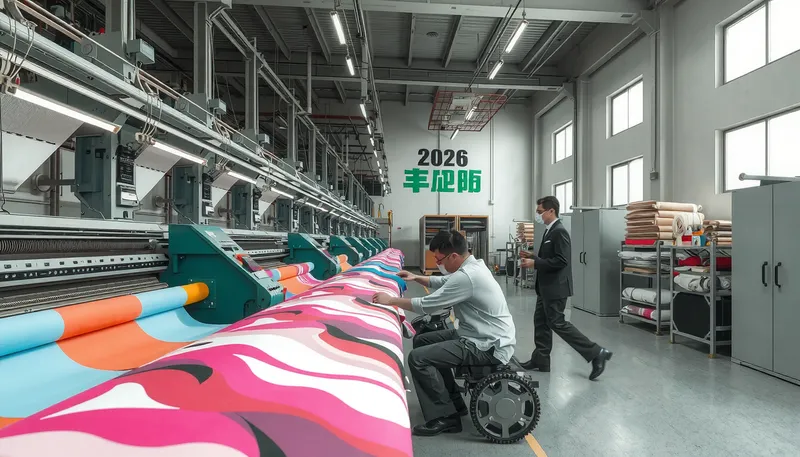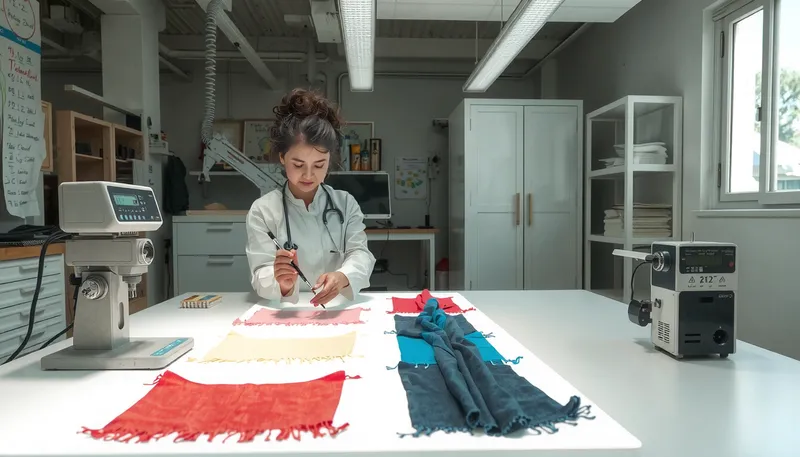
Custom fabric color consistency is achieved through two controls: Delta E (ΔE) spectrophotometer measurement — a dE <1.0 in CIE Lab color space represents a commercially perfect match undetectable by the human eye under D65 illuminant — and dye-lot control: master digital standard creation, formula locking, in-line dE monitoring, and lot-level traceability for identical re-order matching months later.*
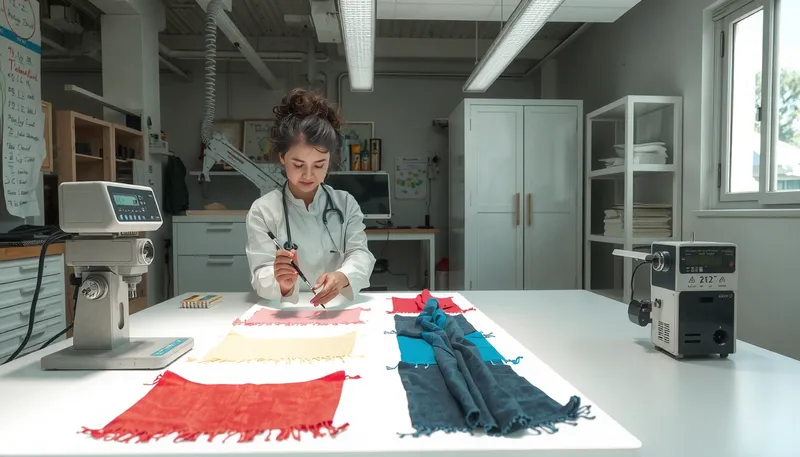
Why Custom Fabric Color Consistency Fails: Metamerism, Fiber, and Process
Three factors cause color inconsistency in custom fabric production: metamerism — color shift under different light sources, measured by Metamerism Index (target MI <1.0 under D65 vs TL84 vs A per CIE 51); fiber-dependent dye uptake — the same dye formula produces different CIE Lab values on nylon vs polyester vs cotton due to varying surface reflectance and dye affinity; and process variables — water hardness, dyeing temperature deviation of ±2°C, and finishing treatments that alter surface reflectance. All three must be controlled for dE <1.0 repeatability.*
Metamerism: When Colors Match in One Light but Not Another
Metamerism occurs when two fabric samples share the same Lab* coordinates under one light source (typically D65 daylight) but diverge under another (e.g., TL84 retail lighting or A incandescent). The root cause is different dye formulations reflecting light spectra differently — even if the integrated color appears identical to a spectrophotometer under the reference illuminant.
To detect metamerism before bulk production:
- Evaluate all lab dips in a standardized light booth under at least three sources: D65 (daylight, 6500K), TL84 (retail fluorescent, 4100K), and A (home incandescent, 2856K)
- Request a Metamerism Index (MI) report — target MI <1.0 per CIE 51 / DIN 6172
- Per ASTM D1729, visual color assessment requires controlled lighting, neutral gray surroundings (Munsell N7), and 45° viewing angle
Fiber Matters: Nylon vs Polyester vs Cotton
The same dye formula applied to different fibers produces different Lab* readings:
| Fiber | Dye Chemistry | Color Risk |
|---|---|---|
| Nylon (PA6/PA66) | Acid dyes — ionic bond, high color yield | Low risk of batch-to-batch shift |
| Polyester | Disperse dyes — no chemical bond, surface adsorption | High risk of wash-down color shift |
| Cotton | Reactive dyes — covalent bond | Moderate risk; dependent on mercerization |
| Blends (Nylon/Spandex) | Acid dye on nylon only — spandex stays undyed | Grin-through risk if spandex >30% |
Specify your target fiber before color matching begins. A Pantone TCX reference matched on nylon will not reproduce on polyester or cotton.
Delta E (ΔE): The Scientific Standard for Color Matching
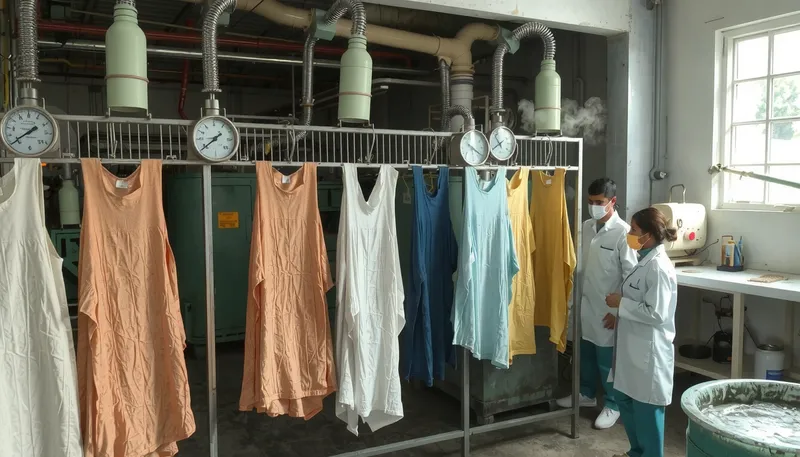
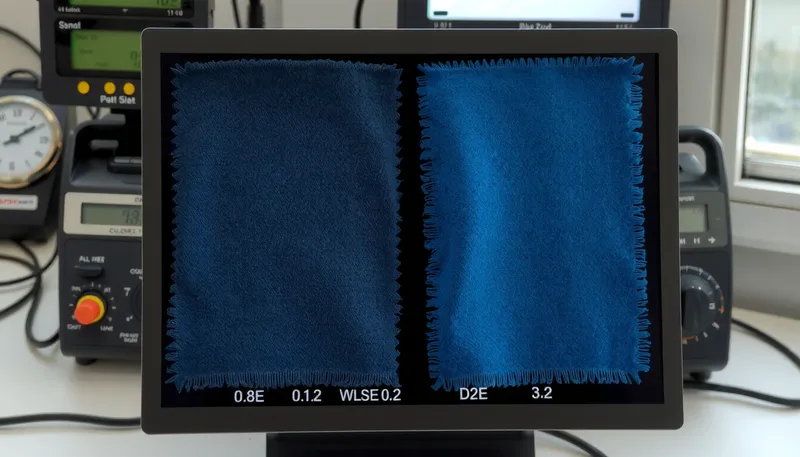
Delta E (ΔE, per CIE 1976 Lab color space, calculated per ISO 105-J03) is the Euclidean distance between two colors in three-dimensional space: L (lightness, 0=black to 100=white), a* (red-green axis), b* (yellow-blue axis). A dE <1.0 is a commercially perfect match — below the human eye's detection threshold under D65 standard illuminant with 10° standard observer. It is recommended for lab dip approval and bulk dye-lot QC. It is not suitable as the sole acceptance metric — metamerism must be evaluated independently under multiple light sources.**
How Delta E is Measured
A spectrophotometer with d/8° sphere geometry (SCI/SCE modes) captures the spectral reflectance of a fabric sample across the visible spectrum (400-700 nm). The instrument calculates Lab* coordinates under the specified illuminant (D65) and observer (10°). Delta E is then computed as:
ΔEab = √[(ΔL)² + (Δa)² + (Δb)²]**
Where ΔL*, Δa*, and Δb* are the differences between the target standard and the dyed sample on each axis. This single number replaces subjective descriptions like "a little too red" or "slightly light" with a repeatable, objective metric.
Delta E Rating Scale
| dE Value | Visual Perception | Industry Application |
|---|---|---|
| <0.5 | No detectable difference even by trained evaluator | Medical / luxury textiles |
| 0.5–1.0 | Undetectable without spectrophotometer | Commercial perfect match — standard for apparel lab dip approval |
| 1.0–2.0 | Slight difference visible under close inspection | Acceptable for mid-market; reject for premium |
| 2.0–3.5 | Clearly visible difference at arm's length | Borderline; not for solid-color panels |
| >3.5 | Readily apparent — different shades | Unacceptable for any apparel application |
For high-end activewear and strict brand color standards, specify dE <1.0 on both lab dips and bulk production samples. A dE of 0.8 vs 1.2 is the difference between a product that matches the line sheet and one that triggers a buyer rejection.
Dye-Lot Control: Scaling Lab Dip Accuracy to Bulk Production
Dye-lot control ensures bulk production color matches the approved lab dip to dE <1.0 through four sequential steps: (1) master digital standard creation — a spectrophotometer reference file capturing Lab coordinates from the approved lab dip; (2) formula locking — computer-controlled dispensing of the exact dye recipe, eliminating manual weighing error (±0.01 g precision); (3) in-line dE monitoring — sampling fabric directly from the dyeing machine against the master standard at defined intervals; (4) lot-level traceability — archiving formulas with unique dye-lot numbers for identical re-order matching 6-18 months later.*
The Four-Step Dye-Lot Control Process
- Master Digital Standard: The approved lab dip is measured by spectrophotometer. Its Lab* values and spectral reflectance curve become the digital master file — the single source of truth against which all production is evaluated.
- Formula Locking: The approved dye recipe is locked into a computer-controlled dispensing system. Dye powders are measured to ±0.01 g accuracy. This eliminates the single largest source of batch variation: manual weighing.
- In-Line Monitoring: During the bulk dyeing run, fabric samples are extracted at 15-minute intervals and measured against the master standard. If dE exceeds 0.8, the dye bath is adjusted before the full batch is affected.
- Dye-Lot Separation & Tracking: Every finished roll receives a unique dye-lot number linked to its formula, process conditions, and Lab* measurement record. When you re-order six months later, the archived formula produces an identical color — no re-matching required.
When dE <1.0 is Not Achievable
Three scenarios where a dE <1.0 target must be adjusted:
- Recycled nylon / Econyl: Base-color variability from post-consumer feedstock makes dE <1.0 on light/pastel shades difficult. Accept dE <1.5 for colors with L* >70.
- Brushed or textured surfaces: The irregular surface scatters light inconsistently. Spectrophotometer readings vary by ±0.3 dE across the fabric surface. Use multi-point averaging (≥5 readings).
- Blends with <50% nylon: Low amine-site density reduces dye uptake consistency. Acid dye printing on ≤50% nylon blends may produce dE variability of 1.5-2.0. Specify dE <1.5 as the acceptance threshold.
2026 Color Technology: Digital Files, AI Recipes, Closed-Loop Systems
Three technology shifts are reducing custom color turnaround from 14 days to 3 days in 2026: digital color communication — .qtx and .cxf file formats replacing physical swatch shipping for instant spectrophotometer-to-spectrophotometer transfer; AI-driven dye recipe prediction — reducing re-dye cycles by 40-60% through first-pass formula accuracy trained on historical dyeing data; and spectrophotometer-to-dispense closed-loop systems — eliminating manual formula transcription errors by linking the measurement device directly to the dye dispensing unit.
- Digital Color Files: Brands send .qtx (X-Rite) or .cxf (CIE Color Exchange Format) files instead of physical Pantone swatches. The receiving spectrophotometer reads the file and the lab system auto-calculates the starting dye formula — cutting 3-5 days of physical shipping.
- AI Recipe Prediction: Machine learning models trained on 10,000+ dyeing records predict the required dye concentrations for a target Lab* with 85-92% first-pass accuracy, down from 50-60% with manual formulation. Each failed attempt costs water, energy, and 24-48 hours.
- Closed-Loop Dispensing: The spectrophotometer output feeds directly to the dye dispensing unit. If the in-line sample measures dE 0.9, the system auto-calculates the correction and dispenses the adjustment without human intervention — eliminating transcription errors.
These technologies do not replace the need for dye-lot control and metamerism testing. They accelerate the iteration cycle, but the final color decision still requires visual confirmation under multiple light sources.
FAQ
What is a lab dip?
A lab dip is a small fabric swatch (10×10 cm) dyed in a laboratory to match a client's color standard — typically a Pantone TCX swatch or a physical fabric cutting. It is the first step in color development, confirming the dye formula before bulk production. A lab dip achieving dE <1.0 against the target standard is approved for bulk scaling.
What is Delta E (ΔE) in simple terms?
Delta E is a single number measuring the mathematical distance between two colors in CIE Lab* space. A dE of 0 means identical colors. A dE <1.0 means the difference is invisible to the human eye. A dE >3.5 means the colors are visibly different. It replaces subjective judgment ("too red, too light") with a repeatable, instrument-based metric.
Why do fabric colors look different under different lighting?
This is metamerism — two samples with different spectral reflectance curves that happen to produce the same integrated Lab* values under one light source (e.g., D65 daylight) but diverge under another (e.g., TL84 retail lighting). Always evaluate lab dips in a light booth under D65 + TL84 + A. Request a Metamerism Index (MI) report with a target MI <1.0.
Can I get a 100% exact color match on every order?
Yes, within instrument tolerance. A "perfect match" in commercial textiles is defined as dE <1.0 — the threshold below which the human eye cannot detect a difference under D65. Through dye-lot control with archived formulas and digital master standards, this result is repeatable across re-orders. A dE of 0.0 is theoretically possible but not practically achievable due to measurement noise (±0.1 dE) and fiber batch variation.
What information do I need to provide for a custom color request?
Provide: (1) a physical color standard — Pantone TCX (cotton) or TPG (paper) swatch, or a fabric cutting of the target shade; (2) the exact fabric base to be dyed — fiber composition, knit structure, and GSM; (3) the required light sources for evaluation (minimum D65 + TL84); (4) the acceptance threshold (standard: dE <1.0). The fabric base is critical — the same Pantone reference produces different Lab* values on nylon vs polyester vs cotton.
Ready to match your custom fabric color?
- Request a custom color lab dip on your target fabric (free, 3-day turnaround)
- Download our dE measurement data pack (n=2,500+ lab dips, first-pass dE <1.0 rate)
- Speak with our color QC engineer for dye-lot specification review
📎 Web: View on Forall Lab
🔗 Related Fabrics
This article covers Delta E color measurement and dye-lot control for custom fabric color matching:
- Acid Digital Print on Nylon Spandex — Acid print color consistency, ionic bond Grade 4-5 fastness
- Color Migration in Activewear — Color migration root cause, Delta E and fastness control
- Tech Pack Fabric Specifications — Color spec writing in tech packs (Pantone / Delta E tolerance)
- Color Fastness to Washing (ISO 105-C06) — Wash fastness color assessment methodology
- D036 Nylon Interlock — Product Page — Reference substrate for custom color matching (76/24, 160 g/m²)
Written by Forall Lab
© Forall Lab • Powered by Kunpeng ONE