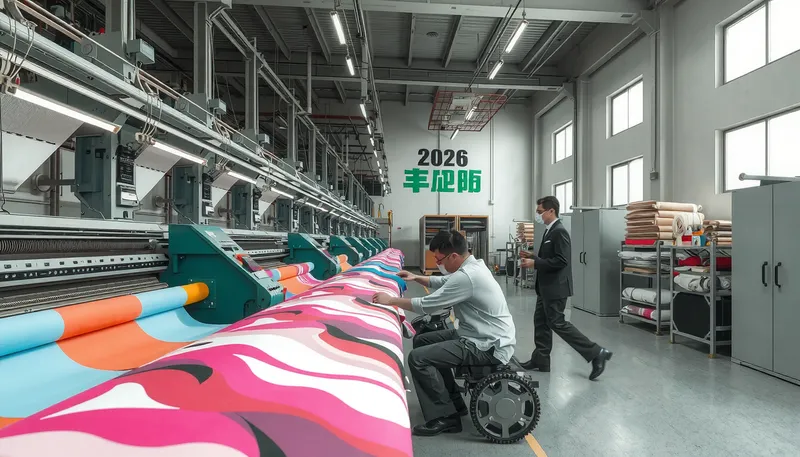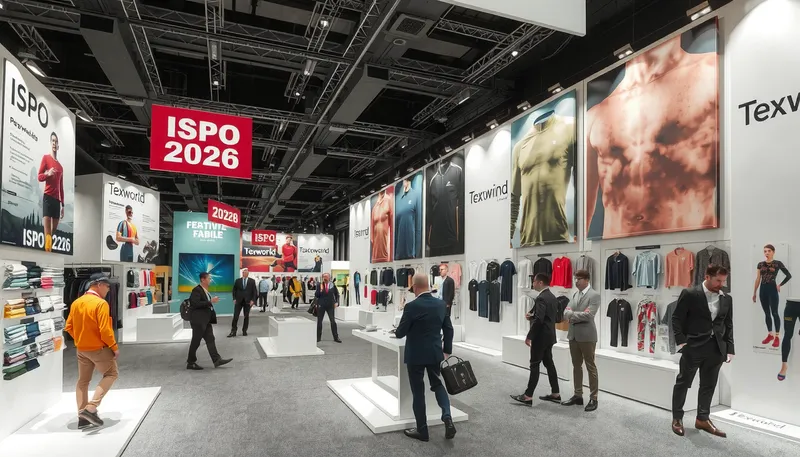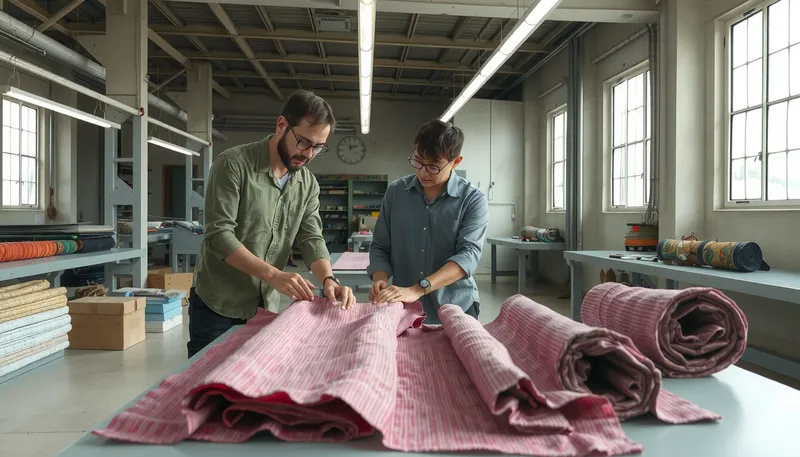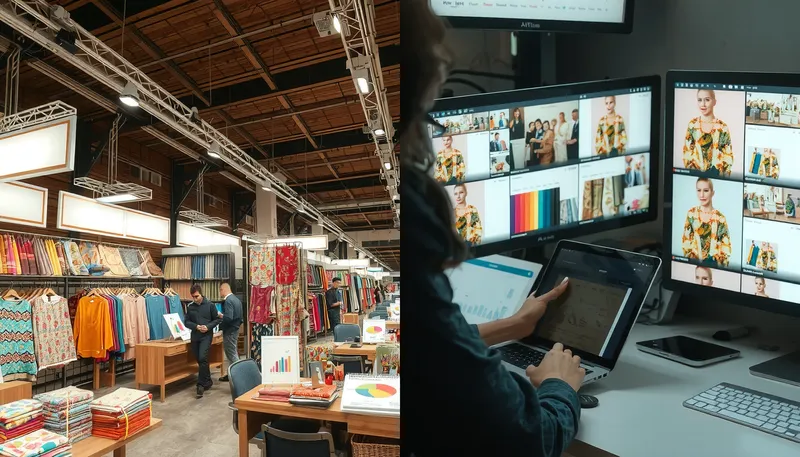
Fabric sourcing in 2026 is a three-channel decision: trade shows ($1,700–$4,250 per trip for tactile evaluation and relationship building), mill-direct digital platforms ($0–$50/month for global supplier access with 48-hour sample delivery), and the hybrid model — digital screening of 50-100 suppliers followed by targeted attendance at one trade show to finalize 3-5 shortlisted partners. The hybrid approach reduces total annual sourcing cost by 40-60% versus trade-show-only while preserving in-person supplier relationship quality. For mill-direct execution after supplier selection, see Import Activewear Fabric (China, HS 6004.10, FOB Incoterms).
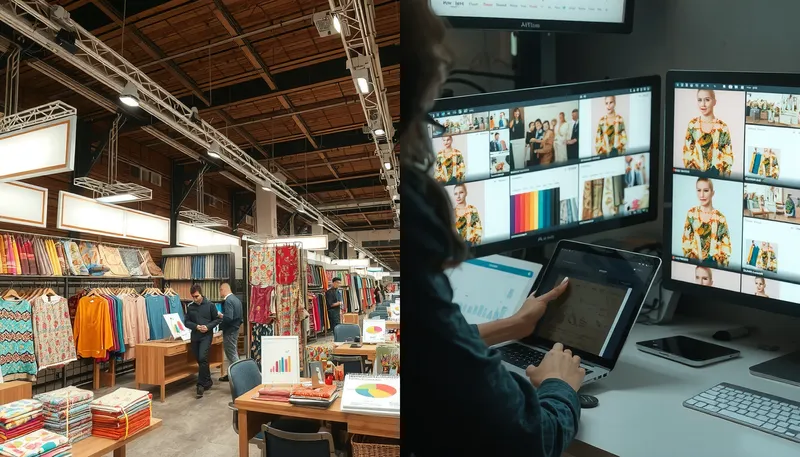
Trade Shows: Three Benefits Digital Platforms Cannot Replace
In-person trade shows deliver three sourcing outputs digital platforms cannot replicate: tactile fabric evaluation — hand-feel, drape, and color accuracy under D65 lighting are not assessable from screen-calibrated photos, and a single touch identifies pilling, surface roughness, and stretch recovery that spec sheets omit; supplier trust formation — a 10-minute face-to-face interaction builds more commitment than 10 email exchanges, cutting post-sampling rejection rates by an estimated 30-40% per industry survey data; and serendipitous discovery — 17% of brands report finding a new primary supplier from an unplanned booth visit at their most recent trade show, according to a 2025 textile industry survey.
Tactile Evaluation: What a Screen Cannot Show
A fabric spec sheet communicates GSM, composition, and width. It does not communicate hand-feel. A nylon spandex interlock at 160 g/m² — the D036 substrate specification — can feel crisp or buttery depending on yarn finish, knit tension, and heat-setting parameters. These variables produce measurable differences in drape coefficient and surface friction that a spectrophotometer cannot capture. At a trade show, you evaluate them in seconds by touch. Remotely, you wait 2-10 business days for a sample that may or may not match expectations.
Three fabric properties that require in-person evaluation:
| Property | Digital Limitation | In-Person Advantage |
|---|---|---|
| Hand-feel (softness, crispness, surface friction) | Photography flattens surface texture; video adds visual but not tactile data | Instant evaluation against reference swatches from current product line |
| Drape (fabric hang and movement) | Static photos and spec sheets provide zero drape data | Hold fabric, observe fold behavior, compare against target garment silhouette |
| Color under D65 lighting | Monitor calibration varies ±2 dE between screens; no two displays render the same L*a*b* identically | Light booth evaluation under D65 + TL84 + A in 30 seconds — eliminates metamerism risk before sampling |
For brands specifying color-critical activewear (see Custom Fabric Colors for dE <1.0 standards), in-person color evaluation under controlled lighting is the only reliable first-pass method. A Pantone TCX reference photographed on an iPhone and viewed on a laptop screen carries an effective dE uncertainty of ±2-3 — three times the commercial acceptance threshold.
Trust Formation: 10 Minutes vs 10 Emails
Supplier relationships in textile sourcing operate on trust — the fabric arrives as specified, on time, with documented QC. Trust forms faster in person. A 10-minute booth conversation reveals supplier technical competence (do they understand their own knitting parameters?), production capacity (can they handle your volume?), and communication alignment (do they answer questions directly or deflect?). The same assessment through email takes 10+ exchanges across 2-3 weeks, during which the supplier may be simultaneously negotiating with 5 other brands.
Serendipitous Discovery: The Unplanned Booth Visit
Pre-planned trade show meetings target known suppliers. Unplanned discoveries — walking past a booth, touching a fabric that stops you, starting an unscripted conversation — produce the highest-value new supplier relationships. A 2025 survey of 200+ activewear brands found 17% identified their current primary fabric supplier from an unscheduled trade show encounter, not from a pre-arranged meeting or digital search. No digital platform replicates the physics of walking a 500-booth exhibition floor.
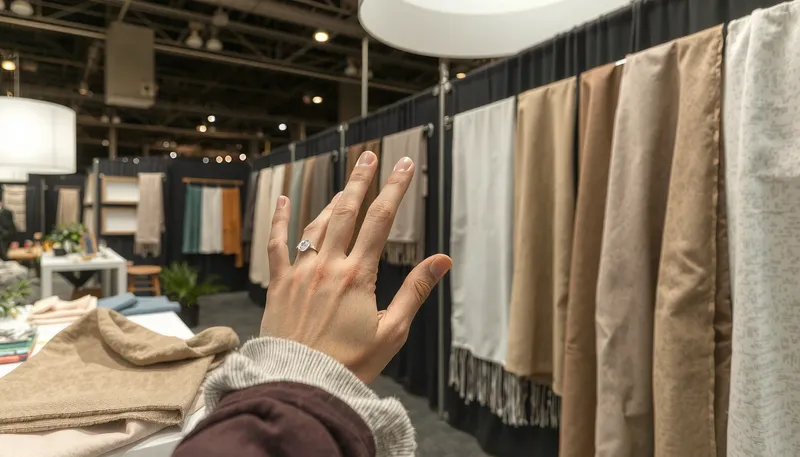
Digital Sourcing: Speed, Scale, and Spec-Based Filtering
Digital fabric platforms reduce supplier discovery time from 3-5 days (trade show floor walk) to 2-4 hours (online search with spec filters) and expand reach from approximately 500 exhibitors per major trade show to 50,000+ suppliers across global platforms. Filter by composition (nylon/polyester/spandex %), weight (GSM 160-320), knit structure (interlock/jersey/rib/air-layer), certifications (OEKO-TEX 100, GRS 4.0, Bluesign), and minimum order quantity (100-500 kg per color). These parameters take hours to verify walking a show floor — online, they are filter checkboxes. Sample delivery: 48 hours for stock fabrics, 3-5 days for custom lab dips, versus 2-4 weeks for post-show follow-up sampling.
Spec-Based Search: Finding the Exact Fabric in Minutes
A brand searching for 76% Nylon / 24% Spandex interlock at 160 g/m² with OEKO-TEX 100 certification and ≤300 kg MOQ per color — the D036 profile — spends 4-6 hours walking a trade show floor, visiting 15-20 booths, and collecting 30+ swatches to find one matching supplier. On a digital platform with spec-based filtering, the same search takes 5-10 minutes, returns 3-8 matching mills globally, and enables side-by-side comparison of technical data sheets before a single sample is ordered.
For example, a digital platform search for "nylon air-layer knit, ≥30% spandex, soft-touch, matte finish" surfaces products like the D083 Air-Sculpt platform: Nylon 20D/24F + Spandex 20D, air-layer knit, 170 g/m², width 140 cm, OEKO-TEX 100 Class II, ASTM D3512 pilling Grade 4 — with a strike-off sample shipped within 48 hours. At a trade show, discovering this specific construction requires either prior knowledge of which booth carries air-layer knits or hours of systematic floor walking.
Digital Verification: Certifications and Remote Audit
Digital platforms enable pre-screening of supplier credentials before committing travel budget:
| Verification Step | Digital Method | In-Person Equivalent |
|---|---|---|
| Business license (manufacturing scope) | Request scan of 营业执照 showing 生产制造 classification | Visit factory registration office |
| OEKO-TEX 100 / GRS 4.0 certification | Request PDF certificate; verify on OEKO-TEX / Textile Exchange online registry | Examine physical certificate at booth |
| Factory capability | Video walkthrough with date verification; live video call from production floor | On-site factory tour (requires separate trip beyond trade show) |
| QC process | Request sample inline QC reports per ASTM D5430 four-point grading at AQL 2.5 | Observe QC station during factory visit |
| Third-party audit | Require SGS / Bureau Veritas / Intertek audit report (dated within 12 months) | Commission on-site audit ($300-500/day) |
Digital verification screens out 60-70% of potential suppliers before any travel cost is incurred — the suppliers who fail to provide certifications, decline video calls, or supply outdated audit reports.
Cost Comparison: Trade Show vs Digital Sourcing
A single trade show trip (Texworld NYC, 3 days) costs $1,700–$4,250 for flights, hotel, and per diem — equivalent to ordering 30-170 stock fabric samples at $10-100 each via digital platforms. The breakeven analysis: if the trade show generates ≥2 new supplier relationships that each convert to a $5,000+ production order, the trip cost amortizes within the first production run. Digital platforms carry near-zero discovery cost but require 2-3× more sample iterations to find the right fabric — because the buyer cannot evaluate hand-feel and drape before ordering the first sample. The hybrid model resolves this: digital screening eliminates 90% of candidates for <$500 in samples, and the trade show trip evaluates the remaining 3-5 finalists in person.
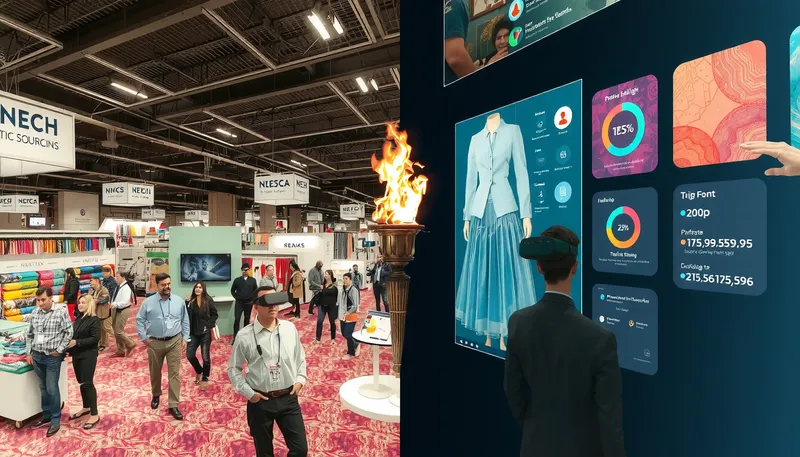
Detailed Cost Breakdown: One Trip vs One Year
| Cost Factor | Trade Show (Single Trip, Texworld NYC, 3 Days) | Digital Platform (Annual, One Platform) |
|---|---|---|
| Travel | Flights: $500–$2,000 (domestic to international) | $0 |
| Accommodation | Hotel 3 nights: $900–$1,500 (NYC rates) | $0 |
| Event Access | Buyer badge: $0–$150 (often free with pre-registration) | Platform subscription: $0–$50/month |
| Daily Expenses | Food + transport: $300–$600 | $0 |
| Sample Cost | Free at booth (limited to available swatches) | $10–$100 per fabric (stock to custom lab dip) |
| Sample Shipping | Carry back or ship: $50–$150 | $30–$150 per batch (5-15 samples) |
| Trip Total | $1,750–$4,400 | $0–$600/year (platform) + $500–$1,500 (samples) |
| Time | 3-5 days (including travel) | 2-4 hours/week ongoing |
| Supplier Reach | ~500 exhibitors per show | 50,000+ suppliers across platforms |
| Lead Time to First Sample | Immediate (booth swatch) or 2-4 weeks (post-show custom) | 48-72 hours (stock) / 3-5 days (custom lab dip) |
Note: Trade show costs are indicative as of 2026 for US-based attendees traveling domestically to Texworld NYC. International attendees (Europe/Asia to US) add $500–$1,500 in airfare. Hotel rates reflect NYC market pricing; regional shows (e.g., Functional Fabric Fair, Portland) reduce accommodation to $400–$700 for 3 nights. Digital platform sample costs assume 10-30 samples ordered per year at $10-100 each.
Breakeven and ROI Calculation
The trade show trip is a capital investment in supplier development. Calculate breakeven:
ROI = (Value of new supplier contracts from this show − Total trip cost) / Total trip cost × 100%
Example: A $3,000 trip yields one new supplier who receives a $15,000 initial production order at a 10% cost saving versus the previous supplier ($1,500 saved). ROI = ($1,500 − $3,000) / $3,000 = −50% — negative on the first order. If that supplier delivers 4 repeat orders annually at the same saving, annualized ROI = ($6,000 − $3,000) / $3,000 = +100%.
The trip becomes ROI-positive when:
- ≥2 new suppliers convert to production within 12 months, OR
- 1 new supplier delivers ≥$3,000 in cost savings (e.g., 15-25% lower fabric cost on a $12,000–$20,000 annual volume)
Below these thresholds, digital-only sourcing produces higher net return because the $3,000 trip cost is reallocated to 30-60 additional fabric samples — increasing the probability of finding the right fabric by expanding the sample pool rather than the travel budget.
The Hybrid Model: Digital Screening → Physical Finalization
The hybrid sourcing model operates in two phases: Phase 1 (Digital Screening) — search 50-100 suppliers online using spec filters (composition, GSM, knit, certifications, MOQ), request PDF certificates and video walkthroughs to verify manufacturer status, order 10-20 stock samples from shortlisted mills at $10-30 each ($200-600 total), narrow to 3-5 finalists based on sample quality, price, and communication responsiveness. Phase 2 (Physical Finalization) — attend one trade show where finalist suppliers exhibit, conduct in-person fabric hand-feel and color evaluation under D65 lighting, and close supplier agreements. This reduces total annual sourcing cost by 40-60% versus attending 3-4 trade shows per year, while preserving in-person relationship quality for the final supplier selection.
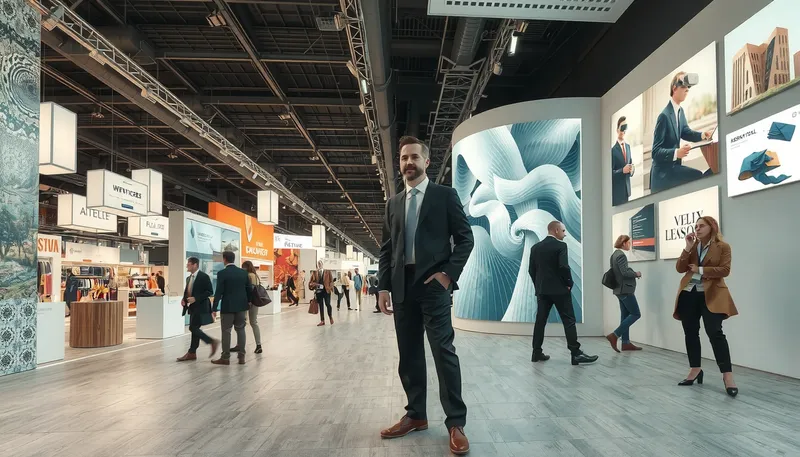
Phase 1: Digital Screening (Weeks 1-4)
- Platform search (Day 1-2): Input target fabric specs. Filter by certification (OEKO-TEX 100 mandatory, GRS optional for recycled content). Exclude suppliers with incomplete profiles or stock photos.
- Credential verification (Day 3-7): Request business license scan, OEKO-TEX certificate, and a 2-minute factory video walkthrough with date verification. Suppliers who decline or delay beyond 48 hours → eliminate. For GRS certification verification methodology.
- Sample order (Day 8-21): Order stock samples (non-custom colors) from 10-20 shortlisted mills at $10-30 each. Ship to one address. Evaluate hand-feel, drape, and stitch a prototype from the top 3 samples. Wash 5 times. Test under intended use conditions.
- Narrow to finalists (Day 22-28): Rank remaining 3-5 suppliers by sample quality, price per meter, MOQ (target ≤300-500 kg per color), lead time (target 4-6 weeks), and communication quality (direct answers vs deflection).
Phase 2: Physical Finalization (Week 5, 3 Days at Trade Show)
- Pre-schedule meetings (2 weeks before show): Email the 3-5 finalist suppliers. Confirm they are exhibiting. Book 20-minute meeting slots at their booths.
- On-site evaluation (Trade show, Day 1-2): Visit each finalist. Compare their booth samples against the stock samples already tested at your studio. Evaluate color under the booth lighting and in a portable light booth if available. Discuss MOQ, lead time, and payment terms face-to-face — these negotiations close faster in person.
- Serendipity margin (Trade show, Day 2-3): Allocate 4-6 hours for unplanned floor walking. Target aisles adjacent to your pre-planned meetings. The 17% serendipitous discovery rate justifies this unstructured time as a deliberate strategy, not wasted hours.
- Close or defer (Post-show, Week 6-8): Send follow-up emails within 48 hours of the show. Confirm pricing, lead time, and first order details discussed at the booth. If no supplier meets requirements, return to Phase 1 with refined search parameters — the digital screening cost is sunk but reusable (the sample library informs the next search).
Hybrid Model Decision Matrix
| Annual Sourcing Budget | Recommended Model | Trade Shows Per Year | Digital Platform Investment |
|---|---|---|---|
| <$5,000 | Digital-only | 0 | $0-600/year platform + all budget to samples |
| $5,000–$15,000 | Hybrid: 1 show | 1 targeted show ($1,700-4,250) | $0-600/year + $200-500 samples |
| $15,000–$50,000 | Hybrid: 2 shows | 2 shows (1 domestic + 1 international) | $0-600/year + $500-1,000 samples |
| >$50,000 | Full coverage | 3-4 shows (Texworld + Première Vision + Functional Fabric Fair + regional) | $0-600/year + $1,000-2,000 samples |
2026 Key Trade Shows: Calendar and Strategic Selection
Four trade shows anchor the 2026 fabric sourcing calendar, each serving a distinct sourcing need: Texworld NYC (January 20-22 & July 21-23, 2026 — Javits Center, ~400 exhibitors, broad apparel fabric range, US market focus, buyer badge free with pre-registration), Première Vision Paris (February 11-13 & September 15-17, 2026 — Parc des Expositions, ~1,200 exhibitors, premium fashion direction, trend forecasting forums, buyer badge ~€50), Functional Fabric Fair (April 14-15 & November 2026 — Portland, OR, ~200 exhibitors, performance/technical/sustainable textiles, buyer badge free), and Interwoven (May 17-20 & November 2026 — High Point, NC, home textiles and upholstery focus). Plan attendance 4-6 months ahead for optimal travel rates and pre-scheduled supplier meetings.
Which Show for Which Need
| Sourcing Goal | Recommended Show | Why |
|---|---|---|
| Broad apparel fabric search (activewear, athleisure, sportswear) | Texworld NYC | Largest US-focused apparel textile show; wide price range from commodity to premium |
| Premium fashion fabric, trend direction, high-end activewear | Première Vision Paris | Industry trendsetter; fabric innovation launches debut here; highest supplier density per square meter |
| Performance/technical textiles, sustainable innovations | Functional Fabric Fair | Focused exclusively on performance knits, membranes, recycled/regen fibers; less crowded, more technical conversations |
| Home textiles, upholstery, contract fabrics | Interwoven (formerly ITA Showtime) | Specialized vertical; not relevant for apparel brands unless expanding to home category |
| Regional sourcing (North Africa) | Morocco International Yarn & Fabric Sourcing Show (dates TBC) | Emerging sourcing hub; lower travel cost for European brands |
| Regional sourcing (Latin America) | LatamTex (dates TBC) | Regional focus; relevant for brands manufacturing in Central/South America |
Pre-Show Preparation Checklist
- Register for buyer badge (free for Texworld NYC, Functional Fabric Fair; €50 for Première Vision) — register ≥8 weeks ahead
- Book flights and hotel (4-6 months ahead for best rates; 2-3 months minimum)
- List 3-5 target fabric specifications (composition, GSM, knit structure, certifications) — print on one page
- Pre-identify 10-15 must-visit exhibitors; email meeting requests with your spec sheet attached
- Pack: color reference standards (Pantone TCX swatches), existing fabric references for hand-feel comparison, portable light booth if budget allows (~$200-400), notebook with pre-printed supplier evaluation template
- Post-show: digitize all business cards and notes within 48 hours; send follow-up emails; log suppliers in your sourcing database
When Trade Shows Are Not the Right Choice
Trade shows deliver negative ROI in three scenarios: brands with established supplier panels — if 80%+ of annual fabric volume already flows through 2-3 stable supplier relationships with consistent quality and pricing, a trade show trip adds discovery cost without discovery need; brands sourcing below 200 kg per color MOQ — most trade show exhibitors represent mills with minimum dye-bath volumes of 300-500 kg, making booth conversations about sub-MOQ orders unproductive; and brands in active production with a 4-week deadline — trade show follow-up sampling and negotiation takes 4-8 weeks to reach a first production order, versus 48-hour sample delivery and 2-week negotiation on digital platforms. For brands in these scenarios, the entire travel budget is better allocated to digital platform samples (30-60 additional fabric evaluations).
Trade Show vs Mill-Direct: Three Sourcing Paths Compared
| Sourcing Path | Cost to Start | Lead Time to First Order | Best For |
|---|---|---|---|
| Trade show → supplier | $1,700–$4,250/trip | 6-10 weeks (post-show sampling + negotiation + production) | Brands discovering new suppliers; tactile evaluation critical |
| Mill-direct digital (Indonesia) | $0-50/month + $200-500 samples | 4-8 weeks (digital sample → negotiation → production) | Brands with defined specs; Form E duty-free access to EU/US |
| Mill-direct digital (China) | $0-50/month + $200-500 samples | 6-10 weeks (sample → lab dip → bulk production → FOB shipping) | Brands with defined specs; HS 6004.10 customs; FOB Incoterms |
FAQ
How far in advance should I plan for a 2026 fabric trade show?
Plan 4-6 months ahead for international shows (Première Vision Paris, Texworld NYC for international attendees). Book flights and hotels at this window for optimal rates. Pre-schedule supplier meetings 3-4 weeks before the show — popular mills book their booth meeting slots 4-6 weeks out. For domestic shows with regional travel, 2-3 months is sufficient.
Is digital fabric sourcing reliable for assessing fabric quality?
Digital sourcing is reliable for spec verification (GSM, composition, width, certifications) but not for hand-feel, drape, or color accuracy evaluation. The process compensates: order 10-20 stock samples from shortlisted digital suppliers at $10-30 each, evaluate them physically at your studio, and narrow to 3-5 finalists before any travel decision. This inverts the traditional model — physical evaluation happens at your desk on your timeline, not compressed into 3 days on a trade show floor.
What is the single biggest mistake at fabric trade shows?
Attending without a pre-printed spec sheet and a pre-scheduled meeting list. Brands that arrive with only a vague objective ("find fabric for next season") spend 60-70% of booth interactions on suppliers outside their GSM range, fiber type, or MOQ bracket. A one-page spec sheet — composition, GSM target ±5%, knit structure, certifications required, MOQ ceiling — filters out unsuitable suppliers before the first handshake.
Should I negotiate prices at a trade show booth?
No. Trade show booth pricing discussions are preliminary and non-binding. Mills quote indicative pricing at shows; the binding price negotiation happens in post-show follow-up when you provide a specific order volume, color count, and delivery timeline — all of which affect the per-meter price. Attempting to close a price at the booth signals inexperience to the supplier. Instead, use the booth conversation to assess technical competence, production capacity, and communication alignment. Price follows trust.
If my budget is under $5,000 annually for sourcing, should I skip trade shows entirely?
Yes. A single trade show trip consumes 35-85% of a $5,000 annual sourcing budget. That $1,700-$4,250 reallocated to digital platform samples buys 30-170 fabric evaluations at your desk — a much wider discovery funnel for the same spend. The hybrid model only becomes ROI-positive when the annual sourcing budget exceeds $5,000, because the trade show trip cost can be amortized across a larger total fabric spend. Below $5,000, digital-only sourcing with physical sample evaluation at your studio is the rational financial choice.
Ready to plan your 2026 sourcing strategy?
- Download the 2026 Fabric Trade Show Calendar with pre-show preparation checklist (PDF)
- Request D036 (76/24 interlock, 160 g/m²) and D083 Air-Sculpt (20D air-layer, 170 g/m²) stock samples for hand-feel evaluation (free, 48-hour delivery)
- Speak with our supply chain engineer for a customized hybrid sourcing plan based on your budget and fabric specifications
🔗 Related Fabrics
This article covers the trade show vs digital sourcing decision for 2026 — the third path in the supply chain triangle alongside mill-direct Indonesia and China import:
- Indonesia Sportswear Factory Direct Sourcing — Indonesia mill-direct path: Form E duty-free (12-18% cost reduction), alternative to trade show sourcing
- Import Activewear Fabric from China: Mill-Direct Guide — China mill-direct: HS 6004.10, FOB Incoterms, ASTM D5430 QC (execution guide after trade show supplier selection)
- GRS Certified Fabric Traceability — GRS import documentation and certificate verification for remote supplier vetting
- Custom Fabric Colors: Delta E & Dye-Lot Control — Delta E color measurement (dE <1.0), D65 lighting evaluation vs screen-based color risk
- D036 Nylon Interlock — Product Page — Reference substrate: 76/24, 160 g/m², interlock, width 155 cm
- D083 Air-Sculpt — Product Page — Nylon 20D/24F + Spandex 20D, air-layer knit, 170 g/m², width 140 cm
Written by Forall Lab
© Forall Lab • Powered by Kunpeng ONE