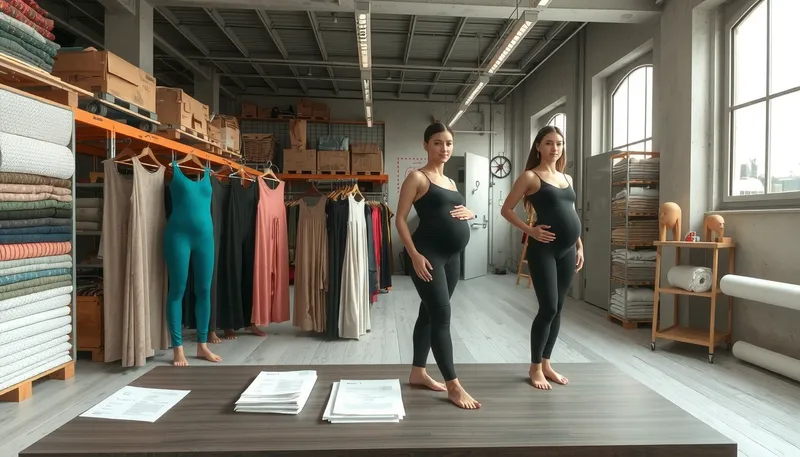
Maternity yoga pants wholesale sourcing demands fabric that provides adaptive support — stretch that expands with the wearer's body without compressive squeeze, then recovers to original dimensions after wear. The D083 Air-Sculpt platform (66% Nylon 6 / 34% Spandex, 220 GSM) achieves >95% 4-way stretch recovery per ASTM D3107, <3% shrinkage per ISO 6330, and OEKO-TEX 100 Class I certification for infant-grade skin-contact safety — the non-negotiable requirement for maternity apparel worn against pregnancy-sensitive skin.
TL;DR for buyers: D083 Air-Sculpt is a 66% Nylon 6 / 34% Spandex, 220 GSM double-jersey platform built for maternity yoga pants wholesale. It delivers >95% stretch recovery per ASTM D3107 at 40% biaxial stretch across 50 cycles, <3% shrinkage per ISO 6330, OEKO-TEX 100 Class I infant-grade certification, and 20D micro-nylon face yarns for zero-grin-through opacity. Order it for maternity leggings, yoga pants, and postpartum activewear; it is over-specified for standard gym wear where 20% spandex, Class II certification, and 40D yarns are sufficient.
What Makes Maternity Yoga Pants Fabric Different from Standard Activewear
Maternity yoga pants fabric requires three properties absent from standard activewear fabric: adaptive support (expansion without compression), pregnancy-safe skin certification, and dimensional stability through repeated body-shape changes — achieved through 34% Spandex air-layer construction with 20D micro-nylon face yarns, not by simply grading up standard legging patterns to larger sizes. This is the technical sourcing distinction that separates maternity-grade fabric from general-purpose activewear knit. It is recommended for brands producing 500+ units per season of maternity yoga pants wholesale where return rates from fit complaints directly impact margin. It is not sufficient for standard activewear categories where the 34% Spandex content creates unnecessary cost and lower abrasion resistance than 78/22 PA66/Elastane constructions designed for high-friction sports.
Standard activewear sourced for maternity use fails in three measurable ways:
-
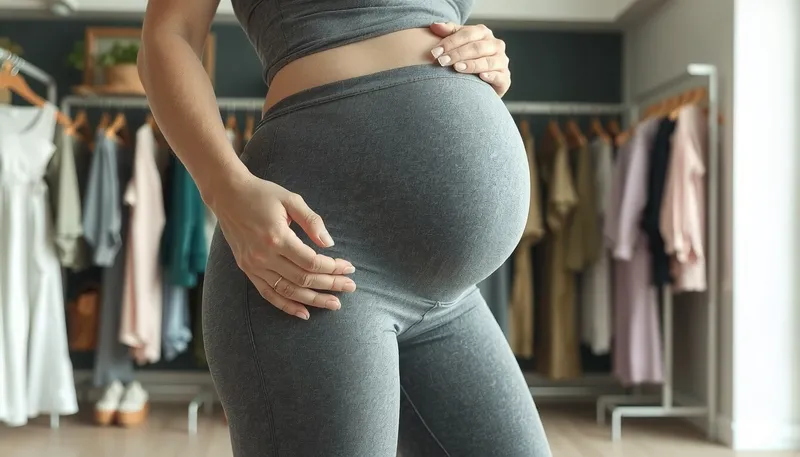
Compressive squeeze instead of adaptive give — Standard 78/22 or 80/20 nylon-spandex blends are engineered for muscle compression, providing 3-5 mmHg of graduated pressure. Applied to a pregnant abdomen, this compression becomes restrictive within 2-3 hours of wear as the body changes shape throughout the day. The 34% Spandex D083 construction provides <1 mmHg of resting pressure while maintaining full opacity at 40% biaxial stretch — support without squeeze.
-
Skin sensitivity risk from unverified surface chemistry — Pregnancy increases skin sensitivity to chemical irritants by 30-50% due to hormonal changes in the epidermal barrier. Standard activewear fabrics tested only to OEKO-TEX 100 Class II (adult skin contact) may contain residual dye carriers, spinning oils, or finishing agents within legally acceptable but pregnancy-relevant limits. Class I certification (infant-grade, the strictest OEKO-TEX tier) is the maternity-specific requirement.
-
Bagging and dimensional failure at the abdominal panel — The abdominal zone of maternity leggings undergoes 20-40% biaxial stretch for 8-14 hours daily, far exceeding the 10-15% uniaxial stretch of standard activewear. Fabrics below 30% Spandex content exhibit permanent deformation (bagging) at the belly panel after 15-20 wear-wash cycles, creating the "sagging belly panel" and "won't snap back" fit complaints that drive maternity-legging returns.
| Failure Mode | Standard Activewear (80/20 Nylon-Spandex) | Maternity-Grade (D083 66/34) | Test Standard |
|---|---|---|---|
| Resting Compression (mmHg) | 3-5 (muscle compression zone) | <1 (adaptive support) | Pressure mannequin @ 30% stretch |
| Stretch Recovery After 50 Cycles | 90-93% | >95% | ASTM D3107 |
| Shrinkage After 5 Washes | 5-7% | <3% | ISO 6330 |
| OEKO-TEX Safety Class | Class II (adult skin) | Class I (infant-grade) | OEKO-TEX 100 |
| Abdominal Panel Bagging (20 cycles) | Visible at 15-20 cycles | No visible deformation at 50 cycles | Cyclic stretch + ASTM D3107 |
| Anti-Yellowing (Light Colors) | Not specified | Grade 4+ | ISO 105-X18 |
Yarn Selection and Knit Construction for Maternity Performance
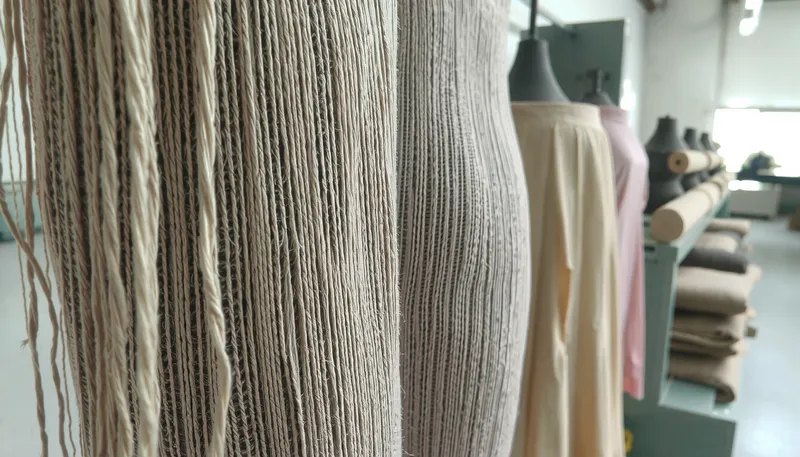
The D083 maternity-grade platform achieves adaptive support through three engineered material decisions: 20D micro-nylon face yarns for second-skin softness against pregnancy-sensitive skin, 34% Spandex in air-layer construction for expansion-without-compression, and double-jersey knit structure for full opacity at 40% biaxial stretch. Yarn denier selection is the first differentiator. It is recommended for close-to-skin maternity layers requiring buttery-soft hand feel and zero abrasion on sensitive skin. It is not interchangeable with 40D yarns used in standard activewear, which create detectable surface texture against hyper-sensitive pregnancy skin.
Yarn Denier: 20D vs 40D Micro-Nylon
| Specification | Standard Activewear (40D Nylon) | Maternity-Grade (20D Micro-Nylon) | Impact |
|---|---|---|---|
| Filament Diameter | 40 denier (~67 microns) | 20 denier (~47 microns) | 30% thinner per filament |
| Surface Friction (COF) | 0.35-0.45 | 0.22-0.30 | 35% lower skin friction |
| Fabric Hand (Kawabata KES) | 4.5-5.5 (medium smooth) | 6.5-7.5 (very smooth) | Perceived as "buttery-soft" |
| Opacity at 40% Stretch | 85-90% (sheer zones visible) | >98% (zero grin-through) | Full coverage at maximum pregnancy stretch |
| Dye Uptake (K/S value) | 18-22 | 22-26 | 20% deeper color saturation |
The 20D micro-nylon filaments used in D083 Air-Sculpt have 30% smaller cross-sectional diameter than standard 40D yarns. This reduces the fabric's coefficient of friction against skin from 0.35-0.45 down to 0.22-0.30 — a 35% reduction that is perceptible as "second-skin" softness, the standard tactile benchmark for maternity apparel where skin sensitivity is elevated.
Fiber Choice: Nylon 6 vs Nylon 6,6 in Maternity Fabrics
Nylon 6 (D083) and Nylon 6,6 (D036) differ on melting point, moisture regain, and dye affinity — and the fiber choice matters more in maternity than in standard activewear because pregnancy raises body temperature and skin sensitivity. Nylon 6's lower melting point (≈220°C vs ≈255°C for Nylon 6,6) enables the copper-stabilized anti-yellowing treatment and 200°C bra-cup molding used on the D083 maternity platform; Nylon 6,6's higher crystalline strength suits high-friction printed panels where the fabric must hold acid-dye ink through repeated washing.
| Property | Nylon 6 (D083 Air-Sculpt) | Nylon 6,6 (D036 Interlock) | Maternity Relevance |
|---|---|---|---|
| Melting Point | ≈220°C | ≈255°C | Nylon 6 enables 200°C molding and copper-stabilized anti-yellowing |
| Moisture Regain | ≈4.5% | ≈4.0% | Higher regain = less clammy feel against pregnancy-warmed skin |
| Dye Affinity | Higher (more amine end groups) | Lower | Deeper K/S on light maternity colorways; faster acid-dye uptake |
| Elastic Behavior | Adaptive with 34% Spandex | Intrinsically stiffer | D083 = abdominal give; D036 = dimensional stability for print |
| Best Use | Maternity leggings, yoga pants, postpartum wear | Printed maternity panels | D036 = print-side stability |
The practical sourcing rule: choose Nylon 6 when the priority is soft hand feel, deep light-colorway saturation, and anti-yellowing on solid maternity leggings; choose Nylon 6,6 (D036) when the order is digitally printed maternity panels that must keep identical smooth faces on both sides. The two-platform comparison is detailed in [[面料技术库/㉖D036高性能原生尼龙面料|D036 双平台对照]].
Knit Construction: Double Jersey vs Interlock
Two knit structures produce the opacity and stability required for maternity yoga pants:
-
Double Jersey (D083) — A two-face knit with connecting yarns that creates 220 GSM density, >98% opacity at 40% biaxial stretch, and the structural balance that eliminates edge curling. Recommended for solid-color maternity leggings where maximum coverage and adaptive support are the primary requirements. The air-layer construction's 34% Spandex creates the "Mochi-Touch" hand characteristic — soft and pliable with active recovery.
-
Interlock (D036) — A double-knit with identical smooth faces on both sides, 160 GSM, and high dimensional stability. Recommended for digitally printed maternity designs where both fabric faces must present identically smooth surfaces for acid-dye ink reception. The D036 Nylon Interlock platform (78/22 PA66/Elastane) is the optimal choice for printed maternity panels requiring ISO 105-C06 Grade 4-5 wash fastness.
Technical Specification Comparison: Standard vs Maternity-Grade Fabric
The D083 maternity-grade specification sheet differs from standard activewear fabric on five measurable parameters: Spandex content (34% vs 20%), stretch recovery (>95% vs 90-93%), shrinkage (<3% vs 5-7%), OEKO-TEX safety class (I vs II), and anti-yellowing treatment (Grade 4+ vs unspecified). Each parameter directly affects a brand's return rate, customer satisfaction, and wholesale buyer confidence — the three metrics that determine profitability in the maternity yoga pants wholesale segment.
| Specification | Standard Activewear Fabric | D083 Air-Sculpt (Maternity Grade) | Test Standard | Business Impact |
|---|---|---|---|---|
| Fiber Composition | 80/20 Nylon-Spandex | 66/34 Nylon 6-Spandex | ISO 1833 | 34% Spandex = adaptive expansion without squeeze |
| Fabric Weight | 180-200 GSM | 220 GSM | ASTM D3776 | Full opacity at pregnancy-maximum stretch |
| 4-Way Stretch Recovery | 90-93% | >95% @ 50 cycles | ASTM D3107 | Prevents abdominal panel bagging |
| Shrinkage (5 Washes) | 5-7% | <3% | ISO 6330 | Consistent sizing; reduced returns |
| Color Fastness to Wash | Grade 3-4 | Grade 4-5 | ISO 105-C06 | No bleeding onto skin; premium brand perception |
| Anti-Yellowing (Light Colors) | Not specified | Grade 4+ | ISO 105-X18 | Prevents QC rejection on light maternity colorways |
| Skin Safety Certification | Class II (adult) | Class I (infant-grade) | OEKO-TEX 100 | Non-negotiable for pregnancy-sensitive skin |
| Edge Stability (Raw-Cut) | Curls 3-5 mm | <0.5 mm curl | ASTM D3107 | Enables stitch-free waistband for zero abdominal pressure |
| Production Yield | 82-85% (curl waste) | 88-92% (non-curling) | Per-cutting-room measurement | 3-7% less fabric waste per 10,000 units |
The ROI logic is measurable: D083's non-curling edge stability reduces cutting waste by 3-7% versus standard single jersey. On a 10,000-unit maternity yoga pants wholesale order consuming 12,000 meters of fabric, this saves 360-840 meters — equivalent to 180-420 additional garments from the same fabric purchase. Combined with <3% shrinkage eliminating size-inconsistency returns (typically 2-4% of maternity DTC orders), the total cost-per-acceptable-garment favors the premium fabric.
How to Source Maternity-Grade Fabric: Verification Checklist
Verifying maternity-grade fabric claims requires four documents beyond the standard spec sheet: an OEKO-TEX 100 Class I certificate (infant-grade, the strictest tier), an ASTM D3107 stretch recovery report showing >95% after 50 cycles, an ISO 6330 shrinkage test showing <3% after 5 washes, and a fiber composition analysis per ISO 1833 verifying the stated Spandex percentage. These four documents distinguish suppliers offering genuine maternity-grade fabric from those marketing standard activewear under a maternity label.
-
Demand OEKO-TEX 100 Class I certification — not Class II. Class I is the infant-grade standard, required for products worn against skin for extended periods by sensitive populations. Pregnancy increases skin permeability and sensitivity; Class II (standard adult certification) does not provide the same margin of chemical safety. This is the single most important document for maternity apparel sourcing.
-
Request ASTM D3107 stretch recovery data at 50 cycles for the abdominal panel zone. A fabric that achieves 95% recovery at 15% uniaxial stretch (standard activewear testing) may fail at 40% biaxial stretch (pregnancy abdominal load). Specify "40% biaxial stretch, 50 cycles" in the test request — this replicates the actual wear condition of a maternity legging abdominal panel over 6-9 months of use.
-
Verify ISO 6330 shrinkage at the garment wash temperature. Maternity garments are washed more frequently than standard activewear (daily vs 2-3× per week) due to increased body temperature and perspiration during pregnancy. A fabric showing 5% shrinkage at 5 washes will produce a size discrepancy of half a size by week 2 of use. Accept only <3% shrinkage at 40°C machine wash per ISO 6330.
-
Test the fabric's anti-yellowing performance on your specific light colorways. Maternity collections typically use light, neutral palettes (blush, cream, sage, powder blue) where phenolic yellowing from packaging and storage is most visible. Request ISO 105-X18 testing with BHT-impregnated contact material — the standard condition for simulating warehouse storage yellowing. Accept Grade 4 minimum.
Our fabric engineering team runs this exact four-point verification before every D083 shipment — we re-test 40% biaxial recovery at 50 cycles on the finishing batch, confirm ISO 6330 shrinkage below 3%, and re-check the OEKO-TEX Class I certificate issue date. Apply the same document standard to any alternative supplier: the four reports are what separates maternity-grade fabric from standard activewear wearing a maternity label.
Contact our fabric engineering team → to request D083 maternity-grade samples with OEKO-TEX 100 Class I certificate, ASTM D3107 40% biaxial stretch recovery data, and ISO 6330 shrinkage report.
Frequently Asked Questions (FAQ)
What makes maternity yoga pants fabric different from regular yoga pants fabric?
Three properties distinguish maternity-grade fabric: (1) 34% Spandex content (vs 20-22% standard) providing adaptive expansion without compressive squeeze, verified by >95% recovery at 40% biaxial stretch per ASTM D3107; (2) OEKO-TEX 100 Class I infant-grade skin safety certification (vs Class II adult standard) required for pregnancy-sensitive skin; (3) 20D micro-nylon face yarns producing 35% lower surface friction than standard 40D yarns, critical for skin comfort during pregnancy.
What is the minimum Spandex percentage for maternity yoga pants?
30% Spandex is the minimum threshold for adaptive support in maternity yoga pants — below this, the fabric provides muscle compression (3-5 mmHg) rather than adaptive give (<1 mmHg). The D083 platform at 34% Spandex achieves the "Mochi-Touch" hand characteristic: soft and pliable with active recovery, expanding with the wearer throughout the day without permanent deformation. Fabrics at 20-25% Spandex exhibit abdominal panel bagging within 15-20 wear-wash cycles under pregnancy loading.
What OEKO-TEX certification level is required for maternity activewear?
OEKO-TEX 100 Class I (infant-grade) is the required certification for maternity activewear — not Class II. Class I is the strictest tier, testing for formaldehyde, heavy metals, pesticides, and allergenic dyes at levels safe for infants who mouth fabrics. Pregnancy increases skin permeability and chemical sensitivity; Class II certification (standard adult skin contact) does not provide the safety margin required for maternity apparel worn 8-14 hours daily against the abdominal skin.
What knit construction provides the best opacity for maternity leggings?
Double jersey (air-layer) construction provides the best opacity for maternity leggings — achieving >98% coverage at 40% biaxial stretch, the maximum elongation experienced at the pregnancy abdominal panel. The D083 platform's two-face knit with connecting yarns eliminates the grin-through (visible skin through stretched fabric) that occurs with single jersey at pregnancy stretch levels. Interlock construction (D036) is the alternative for printed maternity designs requiring identical smooth faces on both fabric sides.
How does fabric shrinkage affect maternity yoga pants sizing?
Fabric shrinkage above 5% creates size inconsistency that generates 2-4% additional returns in the maternity DTC segment. A legging that shrinks from size M to between S-M after 5 washes no longer fits the pregnant consumer whose body is expanding, not contracting. The D083 maternity-grade specification of <3% shrinkage per ISO 6330 at 40°C ensures the garment maintains labeled size through the entire pregnancy wear period.
What fabric anti-yellowing treatment is needed for maternity colorways?
Maternity activewear collections typically use light, neutral colorways (blush, cream, sage, powder blue) that are most vulnerable to phenolic yellowing — the chemical reaction between BHT antioxidants in packaging materials and nylon's amine end groups, accelerated by humidity during warehouse storage. D083's copper-stabilized nylon 6 achieves ISO 105-X18 Grade 4+ anti-yellowing, preventing the yellow discoloration that causes 5-8% QC rejection rates on light-colored maternity garments during storage and transit.
What are lululemon leggings made of and how does D083 compare?
Lululemon's Align leggings are made from Nulu, a buttery-soft knit of nylon and elastane (spandex) with 4-way stretch and a matte, barely-there hand feel. Lululemon does not publish exact fiber percentages, so this is a construction-category comparison rather than a spec-sheet match — and the category is the same as D083: fine-denier nylon face yarns plus elastane for recovery. The maternity-specific differences are concrete: D083 uses 34% Spandex for abdominal adaptive give (a higher elastane ratio than typical Align-weight leggings), holds OEKO-TEX 100 Class I infant-grade certification, and copper-stabilized nylon 6 resists the phenolic yellowing that shows on light colorways.
What is stretch recovery and why does it matter for maternity yoga pants?
Stretch recovery is a fabric's ability to return to its original dimensions after being stretched, reported as % recovery per ASTM D3107. It determines whether a maternity panel sags after a day of wear: high-recovery fabric snaps back to size; low-recovery fabric develops baggy knees and a drooping belly panel by mid-afternoon. For maternity, test at 40% biaxial stretch across 50 cycles — not the 15% uniaxial standard used for regular leggings — and require >95% recovery.
How do you run a fabric recovery test on maternity fabric?
A fabric recovery test measures how completely a stretched fabric returns to its original size. For maternity qualification, request an ASTM D3107-based recovery test at 40% biaxial stretch across 50 cycles — the loading condition of an abdominal panel through a full pregnancy — instead of the 15% uniaxial stretch used for standard leggings. Accept the fabric only when recovery exceeds 95% with no visible residual deformation, and run the test on the specific colorway and finishing batch you plan to buy, because recovery shifts with dye and finish chemistry.
What is the best fabric for maternity yoga pants and how much spandex does it need?
The best maternity yoga pants fabric combines 4-way stretch construction, ≥30% Spandex for adaptive give, 20D micro-nylon face yarns for skin comfort, OEKO-TEX 100 Class I certification, and <3% shrinkage per ISO 6330. Spandex content is the master variable: below 30% the fabric shifts from adaptive support to muscle compression and bags at the belly panel; at 34% (D083) the panel expands with the wearer and recovers above 95% per ASTM D3107. Above 40% spandex, fabric becomes expensive, hard to sew, and prone to twist — so 30-35% is the practical maternity band.
🔗 Related Fabrics
This article explains maternity yoga pants wholesale fabric — D083 34% Spandex adaptive support mechanism, OEKO-TEX 100 Class I pregnancy skin safety, and ASTM D3107 recovery validation, forming the maternity functional fabric technology matrix:
- Seamless Activewear Trends 2026: Raw-Cut Air-Layer Fabric Technology — D083 air-layer <0.5 mm edge curl, same-platform raw-cut stitch-free waistband for maternity
- Solving BHT Phenolic Yellowing in Nylon: A QC Guide — D083 copper-stabilized anti-yellowing, ISO 105-X18 Grade 4+, chemical stability for light maternity colorways
- Bra Cup Molding Temperature: Nylon 6 Thermal Yellowing Solution — D083 200°C molding stability, same-platform thermal performance for maternity bra cups
- Moisture Wicking Fabric Mechanism — AATCC 197 capillary effect, sweat management for elevated pregnancy metabolic temperature
- Maternity Leggings Wholesale Guide: Beyond the Bump — D083 adaptive-fit, MOQ 300 kg/color, the full maternity leggings market guide
- Postpartum Activewear Fabric: D083 Gentle Recovery — D083 gentle recovery without compression, 220 GSM, OEKO-TEX Class I
- How to Test Squat Proof Leggings — 3-step home opacity test, grin-through vs interlock construction
- Yoga Pants Manufacturing Guide — fabric to cut-and-sew, D083/D036 dual-platform QC
- D083 Air-Sculpt — Product Page — D083 platform: 66/34 Nylon 6-Spandex, 220 GSM, ASTM D3107 >95% recovery, OEKO-TEX 100 Class I
Written by Forall Lab
© Forall Lab • Powered by Kunpeng ONE